

3175x175(CURRENT).thumb.jpg.b05acc060982b36f5891ba728e6d953c.jpg)
Qualcomm's new Snapdragon X2 Elite chips are official, and I've stacked them up against the first-gen hardware.


Qualcomm just announced its second-gen Snapdragon X2 Elite chips for laptops during the Snapdragon Summit in Maui, and there are some interesting comparisons to be made to the first-gen X Elite hardware.
I'm focusing on the X2 Elite (X2E-88-100 and X2E-80-100) chips and the X Elite (X1E-84-100, X1E-80-100, and X1E-78-100) chips for this comparison.
Yes, Qualcomm also announced an X2 Elite Extreme version, but I'm waiting for some hard performance numbers before writing a separate comparison. There's also a first-gen X Elite (X1E-00-1DE) chip that was for developer kits, which I've likewise omitted.
I've separated the X2 Elite and X Elite comparison into CPU, GPU, NPU, memory, storage, and just about everything else for easier reading.
Qualcomm X2 Elite vs. X Elite: Oryon CPU

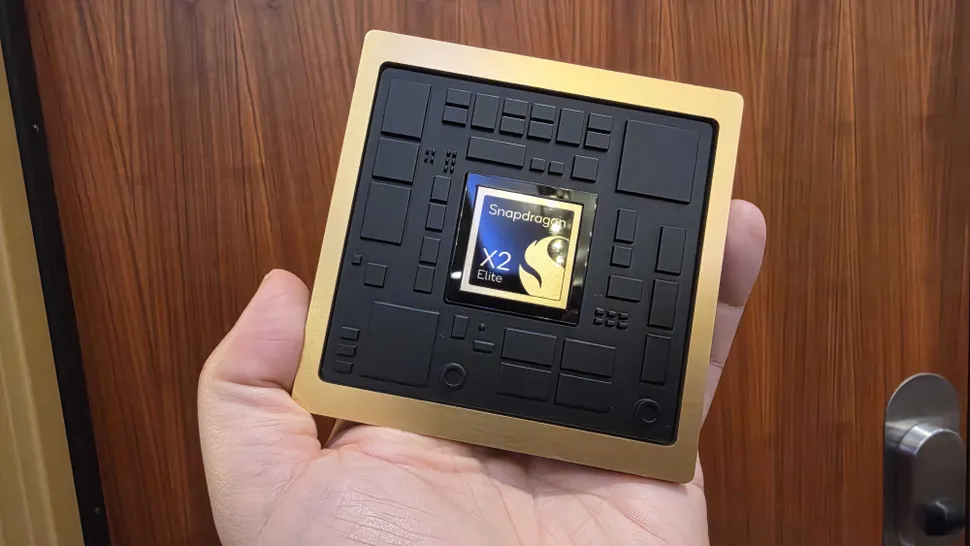
A look at a mock-up Snapdragon X2 Elite SoC. (Image credit: Windows Central)
Qualcomm's Systems-on-Chip (SoC) are designed to package a complete computing setup into one small piece of hardware.
Each chip includes a Qualcomm Oryon processor (CPU), Qualcomm Adreno integrated graphics (GPU), a Qualcomm Hexagon Neural Processing Unit (NPU), memory (RAM), and more.
I'm starting this comparison by looking at how the Snapdragon X2 Elite's Oryon CPU has evolved compared to the first-gen X Elite chips.
Qualcomm's original Snapdragon X Elite Oryon CPUs feature 12 cores, 42MB of cache, and max multi-core frequencies that top out at 3.8GHz, boosting up to 4.2GHz in the X1E-84-100 model. These use a 4nm process.
The most notable change in the X2 Elite's CPU architecture, aside from the new 3nm process that lowers power consumption and boosts performance, is the arrival of new Oryon Prime cores.
They're joined by Oryon Performance cores, which, despite the name, aren't as powerful.
The platform [X2 Elite] boasts up to 31% faster performance at ISO power and requires up to 43% less power than the previous generation [X Elite].
Qualcomm
Qualcomm says that the new core setup is "tuned to provide premium responsiveness and user experiences in everyday workloads with extreme power efficiency."
The more powerful Snapdragon X2 Elite (X2E-88-100) features 18 total cores, split with 12 Prime cores and 6 Performance cores. The Prime cores can hit a 4.0GHz multi-core frequency, temporarily boosting up to 4.7GHz for both single- and dual-core workloads.
The Performance cores seemingly do not include boost capabilities, hitting a maximum 3.4GHz multi-core frequency.
I've done my best to lay out the performance specs for both generations of Elite chips, using the "Performance cores" section in the table below for the first-gen X Elite's cores.
| Row 0 - Cell 0 |
Snapdragon X2 Elite (X2E-88-100) |
Snapdragon X2 Elite (X2E-80-100) |
Snapdragon X Elite (X1E-84-100) |
Snapdragon X Elite (X1E-80-100) |
Snapdragon X Elite (X1E-78-100) |
|
Total cores |
18 |
12 |
12 |
12 |
12 |
|
Prime cores |
12 |
6 |
N/A |
N/A |
N/A |
|
Prime multi-core frequency |
4.0GHz |
4.0GHz |
N/A |
N/A |
N/A |
|
Prime core boost frequency |
4.7GHz (Single- and dual-core) |
4.7GHz (Single-core), 4.4GHz (Dual-core) |
N/A |
N/A |
N/A |
|
Performance cores |
6 |
6 |
12 |
12 |
12 |
|
Performance multi-core frequency |
3.4GHz |
3.4GHz |
N/A |
N/A |
N/A |
|
Max multi-thread frequency |
N/A |
N/A |
3.8GHz |
3.4GHz |
3.4GHz |
|
Dual-core boost |
N/A |
N/A |
4.0GHz |
4.0GHz |
N/A |
|
Total cache |
53MB |
34MB |
42MB |
42MB |
42MB |
The new Snapdragon X2 Elite (X2E-88-100) features a significantly larger cache at 53MB compared to other chips. Even the X2 Elite (X2E-80-100) falls to 34MB, coming in below the original X Elite lineup's 42MB cache.
You'll also notice that Qualcomm is no longer measuring multi-thread frequencies, turning instead to multi-core frequency thanks to the new X2 Elite architecture.
Qualcomm says that the X2 Elite platform "boasts up to 31% faster performance at ISO power" while pulling up to "43% less power than the previous generation."
Qualcomm X2 Elite vs. X Elite: Adreno GPU

A laptop with the original Snapdragon X Elite inside powering a couple of external displays.
(Image credit: Daniel Rubino)
As with the Oryon CPU architecture, Qualcomm has made changes to the architecture of the integrated Adreno GPU.
The Snapdragon X2 Elite (X2E-88) features the same X2-90 GPU as the flagship X2 Elite Extreme, although it's clocked slightly lower at 1.70GHz (compared to 1.85GHz).
The X2 Elite (X2E-80) has a different X2-85 integrated GPU, but it clocks the same as the one in the X2E-88 chip at 1.7GHz.
| Header Cell - Column 0 |
GPU |
Maximum frequency |
TFLOPS |
External display support |
|---|---|---|---|---|
|
Snapdragon X2 Elite (X2E-88-100) |
X2-90 |
Up to 1.70GHz |
N/A |
Up to triple 5K@60Hz or up to triple 4K@144Hz |
|
Snapdragon X2 Elite (X2E-80-100) |
X2-85 |
Up to 1.70GHz |
N/A |
Up to triple 5K@60Hz or up to triple 4K@144Hz |
|
Snapdragon X Elite (X1E-84-100) |
N/A |
Up to 1.50GHz |
4.6 |
Up to triple 4K@60Hz or up to dual 5K@60Hz |
|
Snapdragon X Elite (X1E-80-100) |
N/A |
Up to 1.25GH |
3.8 |
Up to triple 4K@60Hz or up to dual 5K@60Hz |
|
Snapdragon X Elite (X1E-78-100) |
N/A |
Up to 1.25GHz |
3.8 |
Up to triple 4K@60Hz or up to dual 5K@60Hz |
Although Qualcomm doesn't include TFLOPS measurements for the updated Adreno GPUs in the X2 Elite chips, the significantly higher frequencies should indeed translate to a significant power boost.
API support for the first-gen X Elite chips includes DX12, and it appears that Qualcomm has expanded that to DX12.2 Ultimate, Vulkan 1.4, and OpenCL 3.0 for the X2 chips.
External display support has been upgraded to include up to triple 5K@60Hz or triple 4K@144Hz displays. The first-gen X Elite's Adreno GPU topped out at triple 4K@60Hz or dual 5K@60Hz.
Qualcomm states that its "new Qualcomm Adreno GPU architecture offers a 2.3X increase in performance per watt and power efficiency over the previous generation," although the company could be referring only to the X2 Elite Extreme chip.
I'll know more once we have raw performance numbers to look over.
Qualcomm X2 Elite vs. X Elite: Hexagon NPU

The Hexagon NPU inside the new X2 Elite SoCs handles local AI work.
(Image credit: Getty Images)
The chip's NPU is designed specifically to handle local AI work, reducing the need to reach out to the cloud when tapping AI for help.
The original Snapdragon X Elite chips introduced the world's first NPU powerful enough to run Copilot+ AI tools on Windows 11 at 45 TOPS (Trillion Operations Per Second), and the X2 Elite's NPU is once again the most powerful in the world for laptops.
Qualcomm has bumped the NPU up to a whopping 80 TOPS across all the new X2 Elite chips (including the X2 Elite Extreme), so there's really no competition between the two generations.
Qualcomm states that the new NPU is "built to run multiple intelligent experiences concurrently with faster responsiveness and reduced latency," likely owing to the 64-bit architecture and "increased memory access."
If you want the most powerful AI laptop from, well, an AI standpoint, Qualcomm's X2 Elite chips are the best out there before getting into assistance from discrete graphics.
Qualcomm X2 Elite vs. X Elite: Memory & storage
Memory support has been buffed in the X2 Elite chips.
Both the X2E-88 and X2E-80 rely on LPDDR5x-9523MT/s RAM with a 128-bit bus width and 152GB/s bandwidth. The maximum capacity has also been increased to 128GB.
The first-gen X Elite chips all use slower LPDDR5x-8448MT/s RAM with a 16-bit bus, working out to 135GB/s bandwidth. Capacity hits a ceiling at 64GB for the first-gen chips.
Storage support has also been upgraded for the new generation. Whereas first-gen X Elite chips relied on NVMe over PCIe 4.0, the X2 Elite chips now support dual NVMe PCIe 5.0.
The UFS version remains the same at 4.0 for removable flash storage, and the SD standard has been upgraded to SDUC with SD Express as well as SDXC with UHS-I.
Qualcomm X2 Elite vs. X Elite: Everything else
I've so far mainly pointed out the differences between Qualcomm's first- and second-gen Elite chips, but there are a bunch of specs that haven't changed between generations.
The X2 Elite chips continue to offer up to Wi-Fi 7 and Bluetooth 5.4 wireless connectivity; both generations use the Qualcomm FastConnect 7800 system.
Qualcomm upgraded its cellular modem to the newer Snapdragon X75 5G system, but peak download and upload speeds remain at 10Gbps and 3.5Gbps, respectively.
USB support also remains the same with USB4 at 40Gbps, with a maximum of three of these ports in one PC.
One thing that has changed with X2 Elite is the addition of "Snapdragon Guardian Technology." It's a subsystem out-of-band management tool that "combines hardware, software, and cloud services," making it much easier for users to manage their PC from "virtually anywhere."
Hope you enjoyed this news post. Feedback welcome.
Posted Thursday 25 September 2025 at 6:15 pm AEST (my time).
News posts... 2023: 5,800+ | 2024: 5,700+ | 2025 (till end of August): 4,048
Recommended Comments
There are no comments to display.
Join the conversation
You can post now and register later. If you have an account, sign in now to post with your account.
Note: Your post will require moderator approval before it will be visible.