

3175x175(CURRENT).thumb.jpg.b05acc060982b36f5891ba728e6d953c.jpg)

AOMedia's AV2 codec cuts bitrate use by around 30%, improves streaming efficiency, but requires much greater decoding power.
The Alliance for Open Media (AOMedia) was formed back in 2015, and in 2018, the consortium released its AV1 video codec. The royalty-free video format was made such that it could compete with H.265 (HEVC). Over time, the AV1 codec saw slow but steady adoption, with YouTube kicking it off in 2018 , with Netflix following in 2020, and Amazon in 2024. Hardware acceleration support also grew steadily over time from the likes of AMD, Intel, and Nvidia.
Back in 2023, AV2, the successor to AV1, started popping its head up as it gained experimental support. Fast forward three years, and the first final specification version, 1.0.0, of AV2 landed last week. Basically, what this means is that compliant encoders and decoders can now be developed and optimized for a stable AV2 standard without the worry of future incompatibilities.
In terms of benefits, AV2 is said to deliver substantial compression improvements versus AV1. Official AOMedia evaluations report average bitrate reductions of approximately 30–34% at equivalent visual quality,depending on the objective metric used. Thus, a video stream encoded with AV2 can achieve similar perceptible visual quality to AV1 while consuming significantly less bandwidth, which in turn will further reduce content delivery costs thanks to the improved streaming efficiency. The biggest benefits of course, will be in cases of high-resolution formats such as 4K, 8K, HDR, and such.
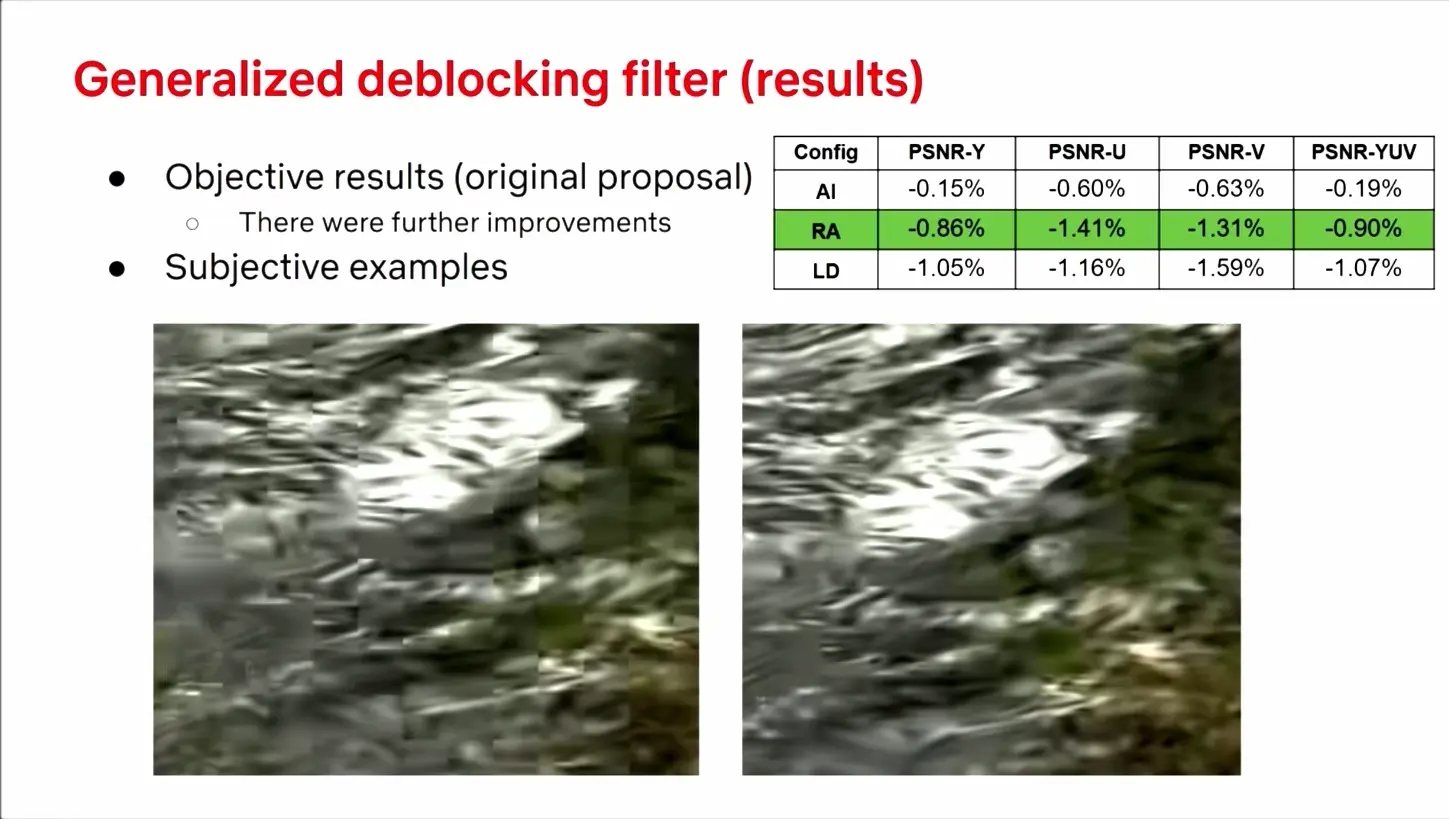
The image above shows the PSNR or Peak Signal to Noise Ratio on AV1 versus AV2. PSNR is a mathematical metric used to measure video compression fidelity; in simple terms, the amount of detail that is preserved after compressing.
To achieve the gains, AV2 introduces several coding improvements, including more advanced intra- and inter-prediction techniques, improved motion modeling, enhanced transform and filtering tools, more flexible partitioning structures, and upgraded entropy coding methods.
Obviously, there is a flip side to this, too, as according to Jean-Baptiste Kempf of VideoLAN, the codec’s increased efficiency comes at the cost of dramatically higher computational complexity. His current estimates suggest AV2 decoding can be roughly five times more complex than AV1 decoding, which will make software playback on many existing CPUs very difficult. Hence, it may not even start getting adopted until there is widespread hardware acceleration support for it.
AOMedia is fairly confident as it expects around 88% of its members to implement the specification within the second half of 2027.
Source: AOMedia via JBKempf blog
Hope you enjoyed this news post. Feedback welcome.
Posted Thursday 4 June 2026 at 8:32 am AEST (my time).
News posts: 2023 5,800+ | 2024 5,700+ | 2025 5,700+ | 2026 (to end of May) 2,092
- Fowler and DKT27
-
 2
2
Recommended Comments
There are no comments to display.
Join the conversation
You can post now and register later. If you have an account, sign in now to post with your account.
Note: Your post will require moderator approval before it will be visible.