

3175x175(CURRENT).thumb.jpg.b05acc060982b36f5891ba728e6d953c.jpg)
Mini PCs are all kinds of awesome but at last we're going to see a serious machine powered by Snapdragon's latest chip.
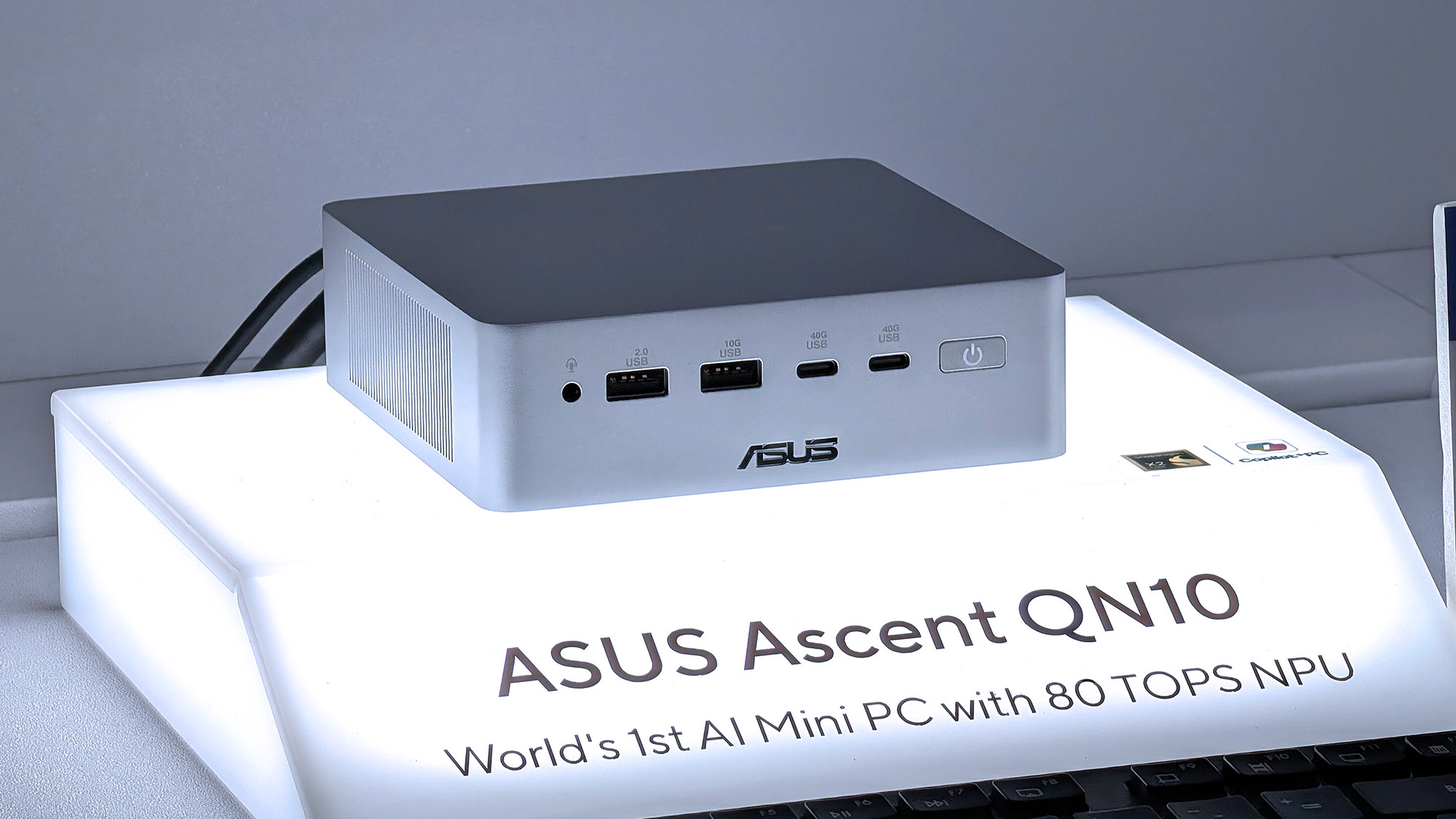
I love mini PCs, and as such, ASUS has all my attention with its dual Computex and Microsoft Build reveal of its new Ascent QN10.
On the outside, it looks like a normal mini PC that could have been made by any of the manufacturers in the space. But inside it has what I've been waiting to see.
Qualcomm's latest Snapdragon X2 Elite. Hoo boy.
So let's get right down to business. The releases from both Build and Computex are, of course, full of talk about AI, and yes, this is very much an AI PC. Like pretty much everything else coming out right now.
But here's what we're looking at on the hardware front.
|
Processor |
Snapdragon X2 Elite |
|
CPU |
3rd Gen Qualcomm Oryon CPU (18 Cores) |
|
GPU |
Qualcomm Adreno X2 |
|
NPU |
Qualcomm Hexagon, 80 TOPS (INT8) |
|
Memory |
Up to 32GB LPDDR5x 8533/9600MHz |
|
Storage |
512GB, 1TB, 2TB max supported (4TB total) 1 x M.2 2280 PCIe Gen 5 SSD + 1 x M.2 2280 PCIe Gen 4 SSD |
|
Network |
Wi-Fi 7; Bluetooth 5.4; Realtek 2.5G LAN |
|
Front I/O Ports |
2x USB4 Type C (DP1.4/PD, 5V/3A, 40Gbps) 2x USB A (1x USB 3.2 + 1x USB 2.0) 1x Audio Jack |
|
Back I/O Ports |
1x USB4 Type C (DP1.4/PD, 5V/3A, 40Gbps) 2x USB A 3.2 1x HDMI 2.1 FRL 1x RJ45 2.5GbE |
|
Display Support |
Up to 4 (HDMI, 3x USB-C) |
|
OS |
Windows 11 Home / Pro 64-bit |
|
Power Adaptor |
180W DC IN charger |
|
Environmental |
Operating Temp: 0-40°C; Storage Temp: -40 to 60°C; Humidity: 0%-92% (non-condensing); Noise Level: Max. 53 dBA @ full speed mode (0 RPM under idle) |
|
Certifications |
BSMI/CB/CE/FCC/UL/CCC/C-Tick/WiFi/RF/VCCI |
|
Dimensions / Weight |
130 × 130 × 40mm / 720g |

As is traditional with a mini PC, you get ports galore on the Ascent QN10.
(Image credit: Zac Bowden | Windows Central)
ASUS is proud to declare the Ascent QN10 as the world's first mini PC with an 80 TOPS NPU inside. Being a Snapdragon X2 Elite-powered device, it'll of course also be fully Copilot+ compatible.
I tried using a mini PC as a primary machine in 2025 and quickly found there are very few drawbacks. Generally they have more ports than I'll ever use, they take up no space, they're quiet and efficient, and they're perfect for an unseasonable British heatwave because they're not spitting great lumps of hot air back into my office.
Whether for work, play, or, yes, AI, a mini PC really can do it all, and there's nothing to suggest the Ascent QN10 will be any different. We already know the Snapdragon X2 Elite is highly capable, and I know first-hand that gaming on a Snapdragon PC isn't as bad as some corners of the internet would have you believe.
There is one factor to consider carefully, though.

The Ascent QN10 doesn't seem to benefit from the ability to house a massive quantity of RAM.
(Image credit: Zac Bowden | Windows Central)
The spec sheet for the Ascent QN10 states that it tops out at 32GB RAM. Admittedly, for the majority of users this is fine. I have 32GB in my own mini PC and equally so in my gaming rig.
But Intel and AMD-powered mini PCs can offer much more than this. The QN10 and its Snapdragon platform uses LPDDR5X memory, which is great, but also not user-upgradeable. By contrast, my own Geekom A9 Max with a Ryzen AI 9 HX 370 at its heart uses SODIMM, which, while slower and less efficient, can be upgraded.
This is the tradeoff we'll have to make. But it does mean that for some workloads, including as an example, running larger local AI models, the QN10 might not be for you.
Nevertheless, I'm excited for this. As a do-it-all machine, it looks like it'll tick more than enough boxes. Windows on Arm is better than its ever been, and Qualcomm is a huge part of that.
Hopefully this kickstarts the rest of the PC makers into having a go themselves and not just with the higher-end chips. What we still need to know is how much it'll cost and when we can get one. But for now, color me impressed.
Hope you enjoyed this news post. Feedback welcome.
Posted Wednesday 3 June 2026 at 2:30 pm AEST (my time).
News posts: 2023 5,800+ | 2024 5,700+ | 2025 5,700+ | 2026 (to end of May) 2,092
- lurch234
-
 1
1
Recommended Comments
There are no comments to display.
Join the conversation
You can post now and register later. If you have an account, sign in now to post with your account.
Note: Your post will require moderator approval before it will be visible.