

3175x175(CURRENT).thumb.jpg.b05acc060982b36f5891ba728e6d953c.jpg)
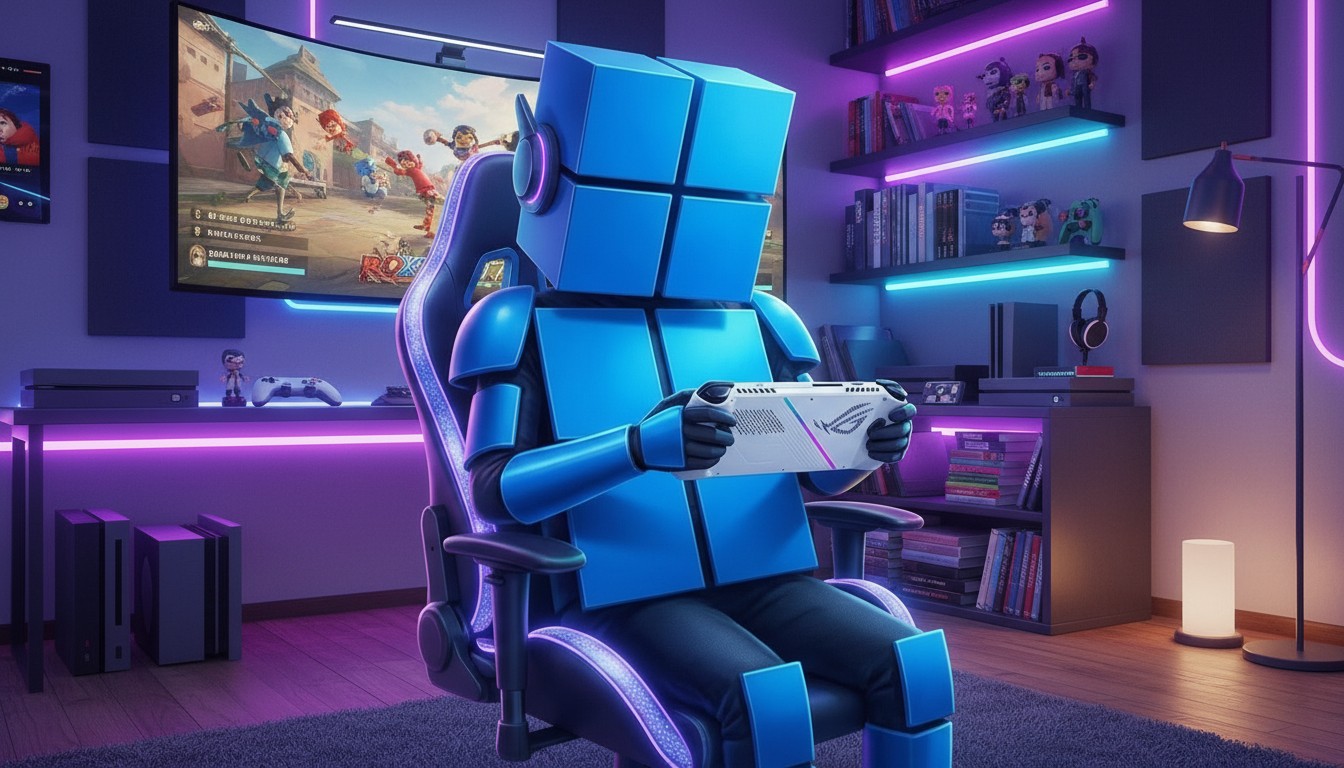
In five years, we'll either have a separate Windows edition for gaming or further hybridization. Here's what those futures might look like.
As I've made it known many times in the past, a big part of the reason why I've stuck with Windows for decades is due to its flexibility. It's the OS that can do practically anything you ask it, for better or worse. You can be a computing genius or a computing bozo and still get something meaningful out of the platform.
Windows was created all those years ago with workflows in mind, but a gargantuan gaming ecosystem has grown up around it over time. That wasn't because Windows was designed for gaming; Windows was simply the platform versatile enough to do so.
The current state of Windows and its gaming foundation

A look at the Xbox Ally X's controls and screen showing Windows in use.
(Image credit: Rebecca Spear / Windows Central)
To say Windows doesn't already have a stable stack of gaming foundation would be disingenuous. Features like DirectX, Auto HDR, DirectStorage (although not as widespread as I'd like it to be), and Game Mode are all features that we as PC gamers kind of take for granted, but they're improving all the time.
Take DirectX 12, Microsoft's suite of APIs that translate communication between games and the hardware they run on, as an example. Microsoft unveiled a new tool called Advanced Shader Delivery in 2025, which speeds up load times and solves stuttering when a game first launches.
To say Windows doesn't already have a stable stack of gaming foundation would be disingenuous.
Elsewhere, Microsoft began paying closer attention to the gaming experience with Windows on ARM in 2025, expanding its Prism emulation layer to support more games that don't run natively on ARM hardware. In the same vein, work is being done to support anti-cheat measures used by some of the most popular competitive games.
Building on its strong foundation, Microsoft launched the Xbox Full Screen Experience (FSE) in 2025, with a redesigned UX focused on gaming. And though it originally launched for handhelds, it's now available to test out on a full PC.
Like it or not, I can't leave out AI integration with the OS. Based on what I've personally experienced with NVIDIA's DLSS 4.5 and tools like multi frame generation (MFG), AI will play a major role in the future of PC gaming. Windows already has an Automatic Super Resolution (Auto SR) feature available in Copilot+ PCs, and it's the only system-level technique on the market.
What a gaming-focused Windows might look like in 2031

A look at the current implementation of the Xbox Full Screen Experience. What might it look like in five years?
(Image credit: Rebecca Spear / Windows Central)
It's impossible to know exactly what Windows will look like in five years, but based on current trends — like Microsoft's plans to make its next Xbox a true gaming PC — I can make some predictions.
I'm imagining two possible outcomes. The first, which is less likely, is that Microsoft creates a separate Windows version designed primarily for gaming. No enterprise or legacy services, way less telemetry running in the background, and no unnecessary software.
It's not hard to imagine the Xbox FSE being the first thing you see when you boot up, with a reliance on controller-first input, seamless integrations for platforms like Steam and Xbox, game saves and game states that sync across your devices, and universal anti-cheat tools that are built into the core of the OS rather than relying on third-party tools.
This sort of "Windows Gaming Edition" would benefit PCs, gaming handhelds, and whatever the next Xbox turns out to be. It would make Game Pass more enticing (subscriptions are only becoming more common), it would directly compete with SteamOS in the handheld and living room markets, and it could also make it easier to develop games.

A look at the Windows 11 taskbar displayed on screen on a laptop.
(Image credit: Future)
The second, more likely, future is one where Microsoft continues to evolve Windows into a hybrid OS. This becomes even more likely when I'm reminded that Microsoft is still rumored to be working on its CorePC initiative, designed to completely overhaul the Windows architecture to make it a lot more modular.
This future would see a full Gaming Mode within the standard Windows, giving users the ability to switch over to a runtime made specifically for gaming. Much like the current Game Mode does now, it would suspend unnecessary background services, set up CPU and GPU scheduling to prioritize games, cut out input latency, and use AI to manage power and integration with third-party GPU tools.
Xbox's FSE also plays a major role in this hybrid future. After all, what better way to introduce a gaming mode than a shell with a slick UX that cuts out all of the non-gaming-related stuff in Windows? AI will undoubtedly play a big role here, too, tying everything together based on exactly how you like to game.
As my colleague Jez Corden points out, one of the biggest concerns surrounding the next Xbox running full Windows is what impact botched updates will have on the experience. The latest Windows updates have been anything but stellar, and creating separate codebases would likely complicate things further. In this regard, a hybrid approach makes more sense.
Windows will have to try hard to fail at being the best place for PC gaming
Microsoft's momentum is carrying it toward a future where Windows isn't just the platform that's best for gaming, but rather the platform that's made for gaming.
It has a sturdy foundation, and as long as it doesn't completely lose the plot, I don't see a landscape where Windows isn't still, by far, the most commonly used OS among gamers.
It's always fun to try and predict the future, and I want to know what you think a gaming-focused Windows might look like in five years time. Let me know in the comments section!
Hope you enjoyed this news post. Feedback welcome.
Posted Wednesday 11 February 2026 at 3:27 am AEST (my time).
News posts: 2023 5,800+ | 2024 5,700+ | 2025 5,700+ | 2026 (to end of January) 461
Recommended Comments
There are no comments to display.
Join the conversation
You can post now and register later. If you have an account, sign in now to post with your account.
Note: Your post will require moderator approval before it will be visible.