


3175x175(CURRENT).thumb.jpg.b05acc060982b36f5891ba728e6d953c.jpg)
Google Chrome will shift from a four-week to a two-week release cycle to roll out new features, bug fixes, and performance improvements more frequently.
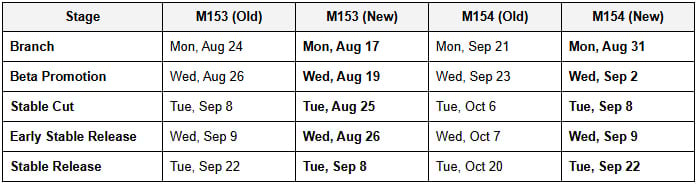
With the release of Chrome 153 on September 8, Google will start shipping two new stable versions of the browser every month, breaking the long-standing schedule developers followed since 2021.
The new model applies to both beta and stable releases across Desktop, Android, and iOS. The new development cycle is reflected in the table below:
However, the Dev and Canary channels for early development and testing will continue on the current schedule. Also, the ‘Extended Stable’ branch will remain on its existing eight-week cycle for enterprise customers who need longer update timelines.
Google says the smaller, more frequent releases will reduce disruption and simplify debugging while maintaining stability due to recent process improvements.
“While releases will be more frequent, their smaller scope minimizes disruption and simplifies post-release debugging,” Google says in a press release.
“And thanks to recent process enhancements, we are confident this shift will maintain our high standards for stability.”
For Chrome users, the impact of this change should not be dramatic, but they can expect to see new feature rollouts more frequently. Chrome updates occur silently in the background, but restart prompts may appear more often now.
Although security fixes will still arrive as part of milestone releases, Chrome will receive weekly security updates according to the current model announced in August 2023.
According to it, Chrome receives security fixes every week to reduce the “patch gap,” shortening the opportunity window for hackers to exploit vulnerabilities in one of the world's most popular web browsers.
With the latest announcement, Google increases the new release cadence for Chrome, building on the previous change, but with a broader, more structural goal this time.
Chrome had a relatively calm start to the year so far, with only one zero-day vulnerability (CVE-2026-2441) reported as actively exploited in the wild. In 2025, hackers leveraged eight Chrome zero-days in attacks.
Hope you enjoyed this news post. Feedback welcome.
Posted Wednesday 4 March 2026 at 6:13 am AEST (my time).
News posts: 2023 5,800+ | 2024 5,700+ | 2025 5,700+ | 2026 (to end of February) 854
Recommended Comments
There are no comments to display.
Join the conversation
You can post now and register later. If you have an account, sign in now to post with your account.
Note: Your post will require moderator approval before it will be visible.