

3175x175(CURRENT).thumb.jpg.b05acc060982b36f5891ba728e6d953c.jpg)
A new system service will roll out this month ahead of big changes starting in September.
Almost 20 years ago, Google pitched Android as the more open alternative to Apple’s walled garden. Last year, Google announced it would begin erecting its own walls through developer verification. The company has issued an update on its plans, affirming that the verification system will begin rolling out in select countries later this year. We’re also learning which app stores are participating in verification and the timeline for key features like the recently revealed “advanced flow” for bypassing verification.
Google has claimed that developer verification is a necessary change to smartphone software distribution, pointing to the increased prevalence of scams that trick Android users into installing malware apps. Google’s solution requires verifying the identities of developers outside the Play Store just like it does for devs publishing on its platform. This has proven to be a contentious change for myriad reasons.
In the new blog post, Google’s Matthew Forsythe confirms that the developer verification system is slated to come online on September 30 of this year. The initial deployment will be limited to countries with a high level of app scams: Brazil, Indonesia, Singapore, and Thailand.
Google released its new developer console back in March, inviting external developers the opportunity to pay $25 and verify their identities early. Developers who don’t register will find that their apps cannot be sideloaded on Google-certified Android devices once verification has rolled out. Google says that almost every app in the Play Store is now ready for the change, and a “large majority” of apps outside Google Play have completed verification.
This system places more burden on developers who want to make software for Android, even if they don’t want to deal with Google directly. There are a few updates that aim to streamline the experience. Google is following through on its promise to extend verification to trusted third-party stores—if a developer is verified in one of these storefronts, they are verified on Google’s side. Google says it will verify the apps in the following stores when it begins enforcing the new restrictions.
- Google (Google Play)
- Honor (HONOR App Market)
- OPlus (OPPO App Market)
- Samsung (Galaxy Store)
- Transsion (Palm Store)
- vivo (V-Appstore)
- Xiaomi (GetApps)
Developers will also have access to new APIs to make registering as an external developer less arduous. In the coming months, Google will release an Android Developer ID Status API that will check if a package name is already registered with Google. The Android Developer Console API will let you register and manage your app package names without leaving your development environment, too.
The countdown begins
The next step toward verifying apps will come this month as Google deploys a new system service on most certified devices. The package (com.google.android.verifier) will appear on phones and tablets running Android 8 or higher, allowing Google to block the installation of unverified apps. It will remain dormant until verification is activated in your specific region.
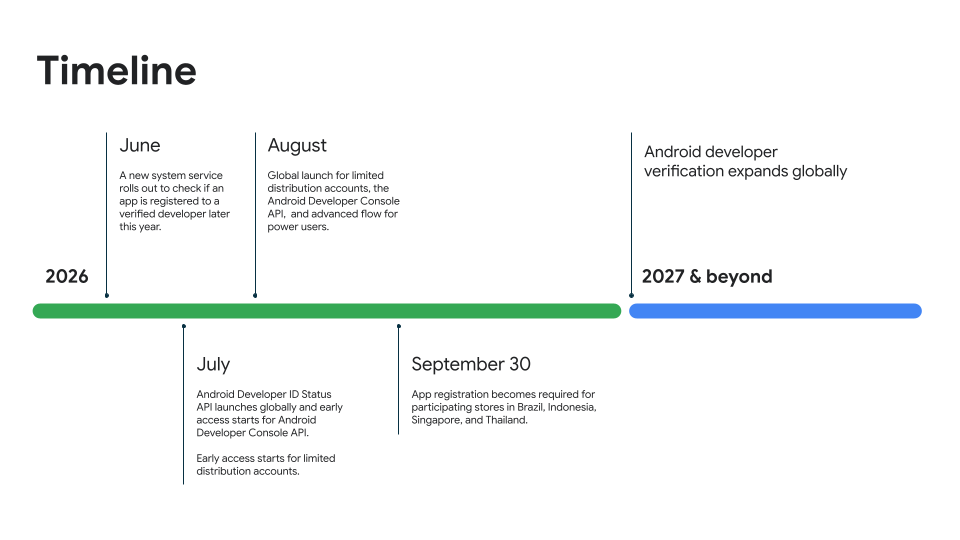
In July, Google plans to roll out the new developer APIs and begin testing for “limited distribution” accounts. This is Google’s solution for hobbyists who want to make their own apps and share them with a small group. Limited accounts won’t require a fee or government ID verification, but you can install these apps on up to 20 devices.
In August, the advanced flow will become available globally ahead of verification becoming mandatory in the first markets. As detailed a few months ago, the advanced flow will allow users to bypass verification, but the process isn’t easy. You’ll have to navigate to a buried menu, confirm you understand the risks multiple times, and wait a whole day before completing the process.
And that brings us to September, when Android devices in Brazil, Indonesia, Singapore, and Thailand will begin checking verification status before installing apps. However, things get murky after that. Google will undoubtedly monitor how verification works as millions of users are suddenly limited to verified apps, which could affect how it moves forward. Google says it intends to expand developer verification in 2027, eventually making it a global device policy.
Hope you enjoyed this news post. Feedback welcome.
Posted Friday 19 June 2026 at 8:21 am AEST (my time).
News posts: 2023 5,800+ | 2024 5,700+ | 2025 5,700+ | 2026 (to end of May) 2,092
- DKT27
-
 1
1
Recommended Comments
There are no comments to display.
Join the conversation
You can post now and register later. If you have an account, sign in now to post with your account.
Note: Your post will require moderator approval before it will be visible.