

3175x175(CURRENT).thumb.jpg.b05acc060982b36f5891ba728e6d953c.jpg)
The key is to evenly distribute elderly passengers, who move more slowly, among the aircraft cabins.
The Federal Aviation Administration (FAA) requires that, in the event of an emergency, all airplane passengers must be able to evacuate any aircraft within a 90-second window. But is that a realistic requirement, particularly given the increasing number of elderly passengers who might need more time and assistance? According to a new paper published in the journal AIP Advances, it is not. Various simulated scenarios showed evacuation times significantly higher than the 90-second requirement.
This isn’t the first time scientists have puzzled over this kind of optimization problem. Back in 2011, Jason Steffen, now a physicist at the University of Nevada, Las Vegas, became intrigued by the question of the most efficient boarding method; he applied the same optimization routine used to solve the famous traveling salesman problem to airline boarding strategies. Steffen fully expected that boarding from the back to the front would be the most efficient strategy and was surprised when his results showed that strategy was actually the least efficient.
The most efficient, aka the “Steffen method,” has the passengers board in a series of waves. Field tests bore out the results, showing that Steffen’s method was almost twice as fast as boarding back-to-front or rotating blocks of rows and 20–30 percent faster than random boarding. The key is parallelism: The ideal scenario is having more than one person sitting down at the same time.
And in 2020, we reported on a study that found it is faster and more efficient to let slower passengers—the elderly or handicapped, people with small children—board first. The authors exploited the well-known connection between microscopic dynamics of interacting particles and macroscopic properties and applied it to the boarding process. In that case, the microscopic interacting particles were the passengers waiting in line to board, and the macroscopic property was how long it took all the passengers to settle into their assigned seats.
This latest study was partially inspired by the Emergency Vacating of Aircraft Cabin (EVAC) Act, introduced in December 2022 by US Congressman Steve Cohen (D-Tenn.), calling for updated evacuation regulations to take into account more realistic cabin conditions. According to the authors, prior research on aircraft passenger evacuation has examined various factors: the effect of different landing attitudes of Airbus A350-900 planes; increasing passenger obesity; passengers obstructing others by attempting to retrieve their luggage; and the impact of passenger fear, anxiety, and panic on optimal evacuation times, among other examples.
Any air traveler has experienced the limited seat pitch and narrow aisles of newer aircraft. Those and other aspects can pose challenges to the increasing number of elderly passengers that the current regulations simply don’t address. Elderly passengers tend to have slower reaction times and mobility issues and are more likely to require assistance. They may also have vision or hearing limitations. Age-related cognitive decline could impair their situational awareness, particularly in a high-stress situation like an aircraft evacuation, resulting in possible delayed decision-making, lower situational awareness, and reduced compliance with crew instructions. Yet there has only been limited research taking elderly passengers into account when studying efficient aircraft evacuation.
A 3D full-scale geometric model
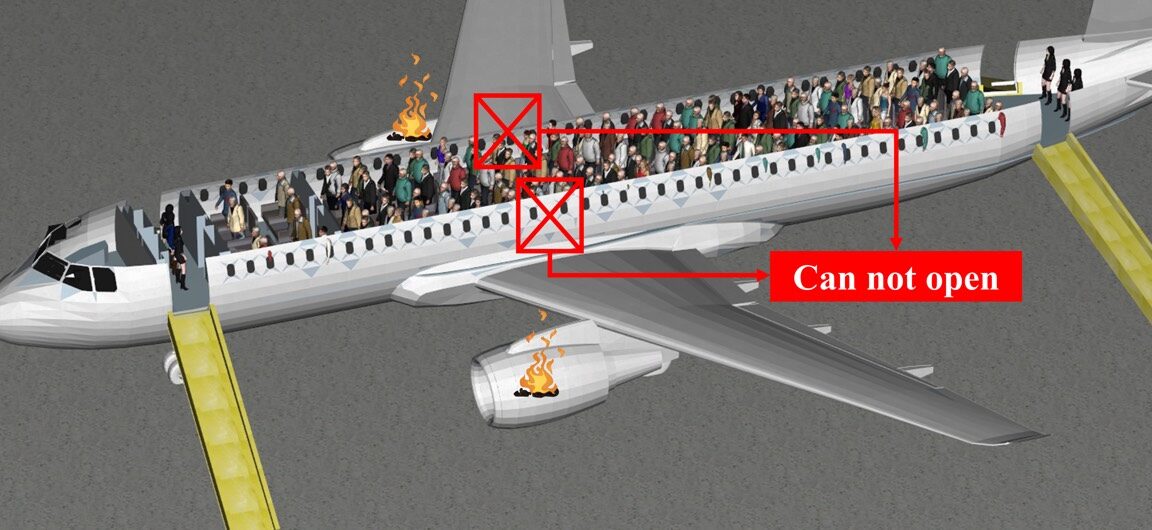
The authors decided to simulate various evacuation scenarios for an Airbus A320, one of the most common narrow-body aircraft worldwide, by using the Rhino 3D CAD tool to construct a full-scale geometric model of the A320, including seat rows, aisles, and exits. This was then imported into the agent-based evacuation simulation platform Pathfinder to model passenger behavior. The team focused on dual-engine fire scenarios, an infrequent occurrence that nonetheless poses greater risks and can render over-wing exits unusable, since both engines in the Airbus 320 are mounted directly under those exits. In such a scenario, all passengers would need to exit the aircraft through the front and rear exits.
“While a dual-engine fire scenario is statistically rare, it falls under the broader category of dual-engine failures and critical emergencies in aviation. History has shown that dual-engine failures and emergencies, such as the famous ‘Miracle on the Hudson’ involving Captain Sullenberger, can happen and lead to severe consequences,” said co-author Chenyang (Luca) Zhang of the University of Calgary in Canada. “Our study focuses on these low-probability but high-impact events to ensure the highest safety standards.”
Zhang et al. created two passenger categories: elderly adults age 60 and older and those younger than 60 years. They modeled three different ratios of those two categories—youth-dominated, evenly balanced, and elderly dominated evacuation scenarios—to capture more realistic travel dynamics and exclude edge cases (e.g., all non-elderly or all-elderly scenarios). For each of those, the model looked at three distinct seating patterns: one where elderly passengers are evenly distributed in areas near the exits; one where the elderly were concentrated in the middle of the cabin, away from the exits; and one where elderly passengers were randomly distributed throughout the cabin.
None of the tested conditions resulted in evacuation times within the FAA-mandated 90 seconds. The shortest evacuation time—20 percent elderly passengers evenly distributed near the exits—was 141 seconds. The longest—involving 80 percent elderly passengers and the same near-exit seating distribution—was 218.5 seconds.
Zhang et al. acknowledge that their study has some limitations. For instance, not all elderly passengers are the same, and their models did not incorporate the need for crew assistance for decreased mobility or similar issues. And because they focused on just the dual-engine fire scenario, their findings might not be generalizable to other evacuation scenarios.
The authors suggest future simulations could be more accurate with the addition of empirical data from real aircraft environments under controlled conditions. Future research should also test the effectiveness of different behavioral interventions, such as providing extra safety briefings tailored to elderly passengers. Airbus and other aircraft manufacturers might also consider redesigning cabins with designated seating areas for elderly passengers, giving them easier access to exits, better visibility, wider aisles, or perhaps armrests to assist with mobility.
AIP Advances, 2026. DOI: 10.1063/5.0310405 (About DOIs).
Hope you enjoyed this news post. Feedback welcome.
Posted Wednesday 1 April 2026 at 5:45 am AEST (my time).
News posts: 2023 5,800+ | 2024 5,700+ | 2025 5,700+ | 2026 (to end of March) 1,297
Recommended Comments
There are no comments to display.
Join the conversation
You can post now and register later. If you have an account, sign in now to post with your account.
Note: Your post will require moderator approval before it will be visible.