

3175x175(CURRENT).thumb.jpg.b05acc060982b36f5891ba728e6d953c.jpg)
Side-by-side views bring new insight into these intriguing clusters.
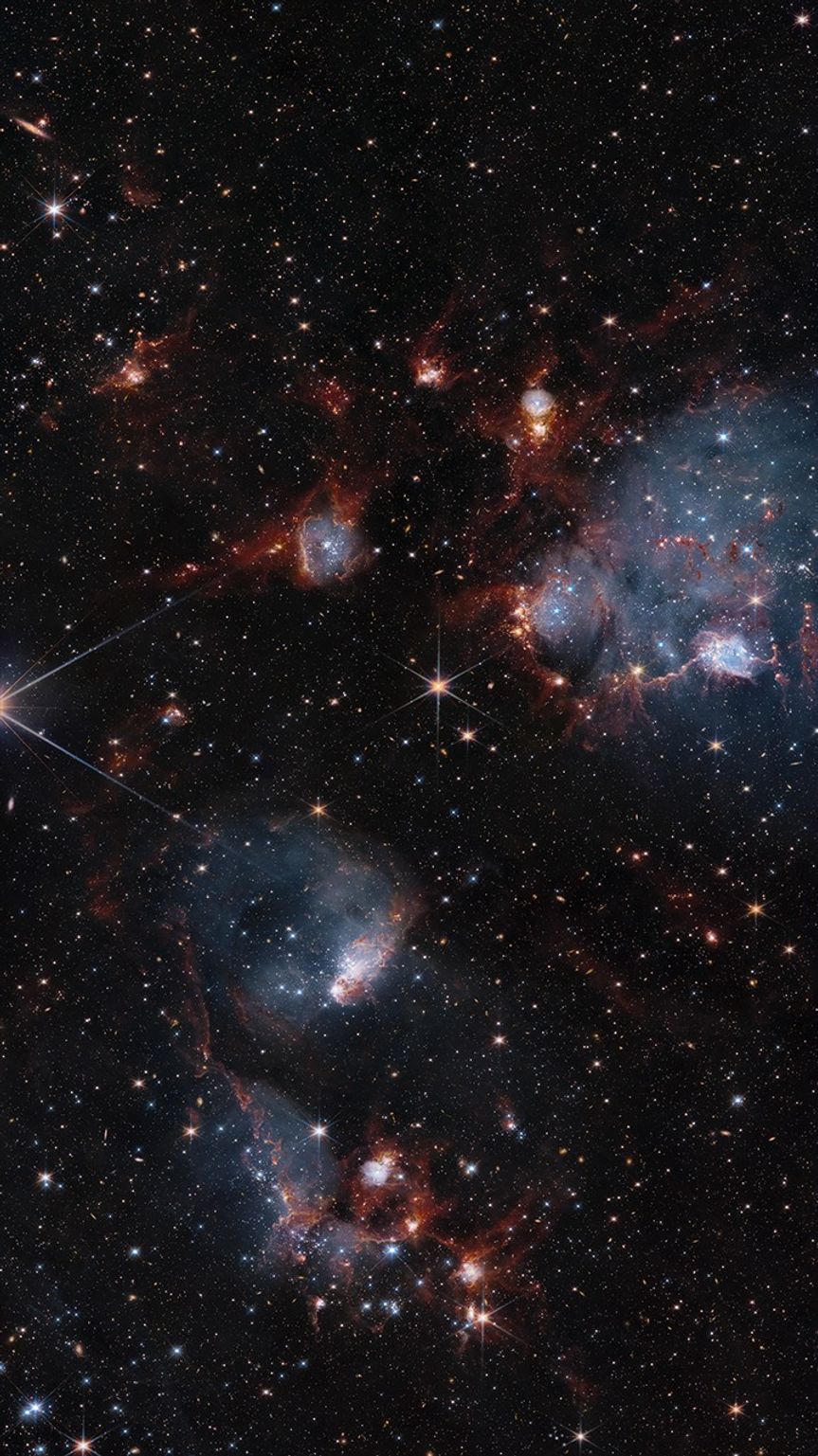
A vast network of stars, gas, and dust is strung
among a duo of star clusters in this combined image
from NASA’s Hubble and Webb space telescopes.
Credit: NASA, ESA, and C. Lindberg (The Johns
Hopkins University); Processing: Gladys Kober
(NASA/Catholic University of America)
Welcome to the Tuesday Telescope. There is a little too much darkness in this world and not enough light—a little too much pseudoscience and not enough science. We’ll let other publications offer you a daily horoscope. At Ars Technica, we’ll take a different route, finding inspiration from very real images of a universe that is filled with stars and wonder.
Open clusters of stars—which consist of dozens up to a few thousand stars—are an interesting tool for astronomers to study the Universe.
That's because all of the stars in such a cluster formed more or less at the same time, allowing astronomers to compare different types of stars, in terms of size and composition, which are all of a similar age. This is useful for understanding how different kinds of stars evolve over time.
Some of these open clusters are pretty famous, such as the Pleiades cluster, also known as the Seven Sisters. This is relatively close to Earth, just 444 light-years away. Others are much more distant, such as NGC 460 and NGC 456. They reside in a nearby galaxy, the Small Magellanic Cloud, and are the subject of today's post.
NASA has shared side-by-side views of these clusters taken in visible light by the Hubble Space Telescope and in infrared light by the James Webb Space Telescope. Hubble's image captures the glowing, ionized gas as stellar radiation produces what look like bubbles in the clouds of gas and dust, whereas Webb highlights the clumps and delicate filamentary structures of dust.
Today's image combines the two into a single composite, based on 12 overlapping observations. It's quite spectacular.
Source: NASA
Hope you enjoyed this news post.
Thank you for appreciating my time and effort posting news every day for many years.
News posts... 2023: 5,800+ | 2024: 5,700+ | 2025 (till end of June): 2,864
RIP Matrix | Farewell my friend
Recommended Comments
There are no comments to display.
Join the conversation
You can post now and register later. If you have an account, sign in now to post with your account.
Note: Your post will require moderator approval before it will be visible.