

3175x175(CURRENT).thumb.jpg.b05acc060982b36f5891ba728e6d953c.jpg)
“Now offloading propellant. Next launch attempt hopefully in a few days.”
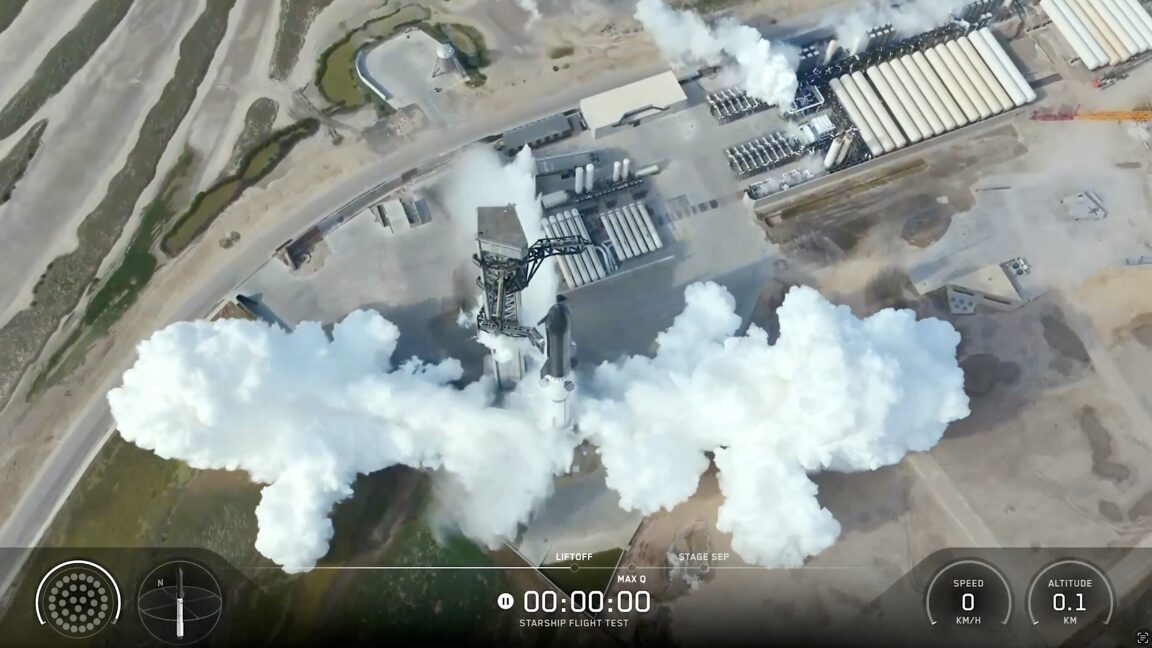
SpaceX called off a test flight of its powerful Starship rocket and Super Heavy booster as the countdown clock reached zero Thursday at the company’s spaceport in South Texas.
The launch team at Starbase, Texas, just north of the US-Mexico border, aimed to launch the more than 400-foot-tall rocket at 5:45 pm local time (6:45 pm EDT; 22:45 UTC). The countdown proceeded smoothly throughout the day, culminating in the loading of more than 11.5 million pounds of liquid methane and liquid oxygen into the two-stage rocket.
But the computers controlling the countdown called an abort during the Super Heavy booster’s engine startup sequence. SpaceX scrubbed the launch attempt, and engineers began preparations to drain the rocket’s propellant tanks. Officials did not immediately announce when they plan to try to launch again.
Elon Musk, SpaceX’s founder and CEO, posted on his social media platform X that the company might not be able to launch during the next available opportunity on Friday evening. “Some of the engines didn’t start, triggering an automatic launch abort,” Musk wrote. “Now offloading propellant. Next launch attempt hopefully in a few days.”
Later Thursday evening, Musk added that ground teams at Starbase will replace two of the Raptor engines on the Super Heavy booster. “Most probable launch timing is early next week.”
Tuning the engine
The Super Heavy booster has 33 methane-fueled Raptor engines, each capable of generating more than half a million pounds of thrust. The engines are supposed to ignite in a staggered sequence after activation of the launch pad’s water-cooled flame diverter, designed to protect the launch facility from the intense heat and vibrations during liftoff of the world’s most powerful rocket.
SpaceX officials did not say how many engines failed to start during the ignition sequence, but a graphic of engine status on SpaceX’s live video stream indicated four of the 33 engines never ignited. The engines on this Starship and Super Heavy come from SpaceX’s third-generation Raptor design. This test flight—the 13th full-scale Starship launch—is the second to use the Raptor 3 engine flying on SpaceX’s upgraded Starship Version 3 rocket.
The Starship V3 rocket and Raptor 3 engine debuted on a mostly successful test flight in May. The Raptor 3s on that mission experienced in-flight issues, but the startup sequence on the launch pad went off without a hitch.
SpaceX’s goals for Flight 13 of Starship include testing several changes intended to overcome the engine issues on Flight 12 two months ago. One of the corrective actions involves modifying the engine startup sequence on the Super Heavy booster during its flip maneuver after separating from the Starship upper stage a few minutes after liftoff.
“At stage separation on Flight 12, slight differences in engine startup on the ship caused the directional flip of the booster to be off by approximately 90 degrees,” SpaceX wrote in a recap of the May launch. “The startup sequence has been modified to be more robust to timing variability and more reliably flip in the desired direction, which is done to increase overall performance.”
Some of the booster’s 33 engines also failed to reignite during the booster’s landing burn in May, preventing it from completing a controlled splashdown in the Gulf of Mexico. SpaceX officials hope to achieve that goal on Flight 13, paving the way for the return of future reusable Super Heavy boosters to the launch site. The company already demonstrated this with Starship V2, but not with Starship V3.
One of the six Raptor engines on Starship’s upper stage also shut down prematurely on the last test flight. The ship overcame the engine failure and continued flying toward a pinpoint water landing in the Indian Ocean, but SpaceX had to skip an attempt to reignite a Raptor engine in space. That was the other major box left unchecked from Flight 12 that SpaceX wants to demonstrate on Flight 13.
A successful test flight with the next Starship would help clear the way for SpaceX to move to an orbital flight, a step toward using Starship for Starlink satellite launches and orbital refueling tests. This, in turn, would move Starship closer to readiness for flights to the Moon in support of NASA’s Artemis lunar lander program.
Updated at 8:15 pm EDT (00:15 UTC) with additional details and confirmation of engine swap.
Hope you enjoyed this news post. Feedback welcome.
Posted Friday 17 July 2026 at 1:29 pm AEST (my time).
News posts: 2023 5,800+ | 2024 5,700+ | 2025 5,700+ | 2026 (to end of June) 2,475
Recommended Comments
There are no comments to display.
Join the conversation
You can post now and register later. If you have an account, sign in now to post with your account.
Note: Your post will require moderator approval before it will be visible.