

3175x175(CURRENT).thumb.jpg.b05acc060982b36f5891ba728e6d953c.jpg)
Scientists directly observed a black hole twisting spacetime, confirming Einstein's century-old frame-dragging prediction experimentally.
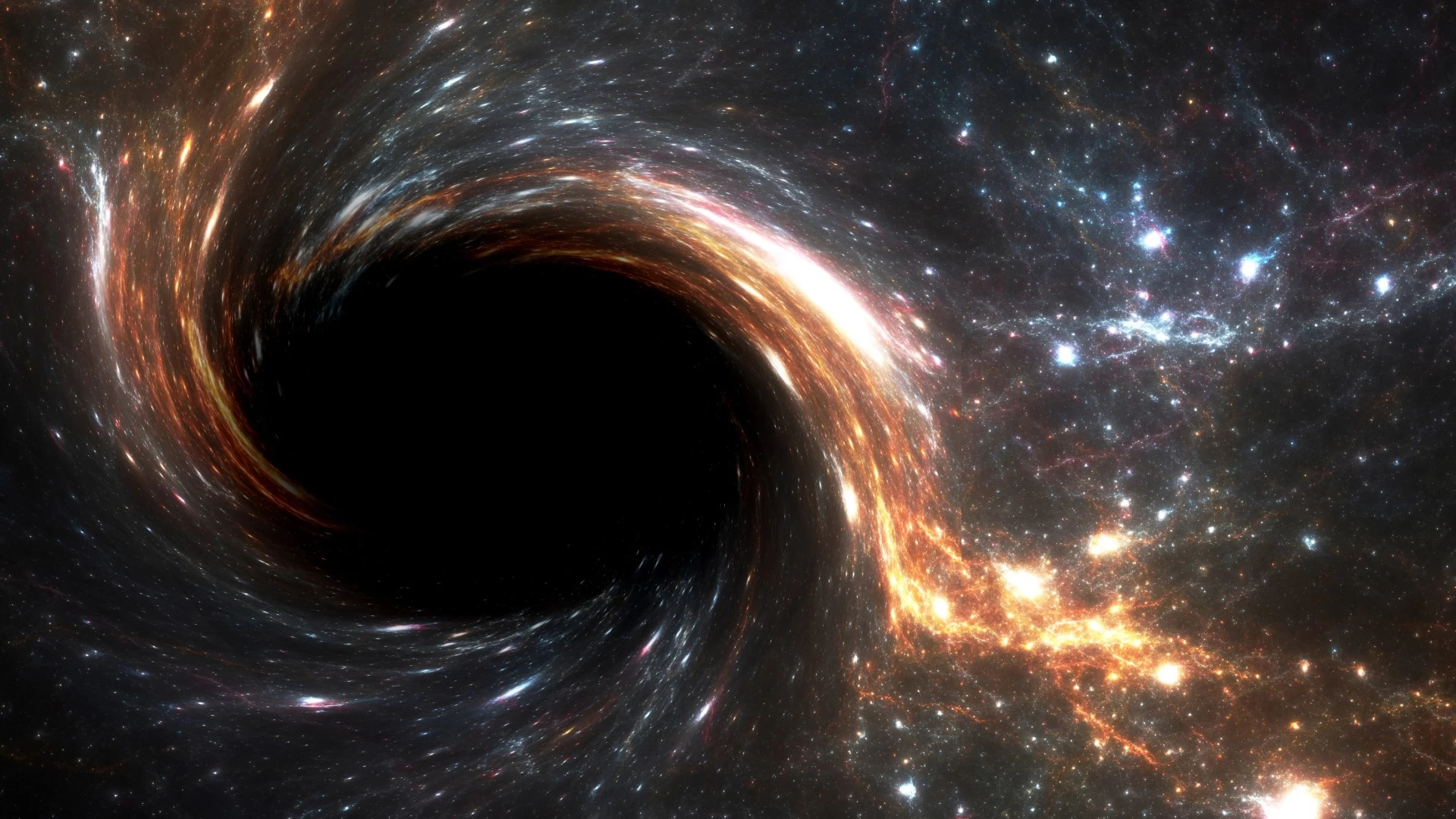
Scientists have captured the first clear evidence of a swirling vortex in spacetime — the four-dimensional framework combining space and time described by Einstein’s theory of general relativity — something predicted more than a century ago but never directly observed until now. The discovery, published in Science Advances, shows how a black hole — an object so dense that not even light can escape its gravity — can twist the very fabric of spacetime around it, pulling nearby matter into a wobbling motion.
The effect is called Lense-Thirring precession, or frame-dragging. It happens when a rapidly spinning black hole drags surrounding spacetime along with it, much like a spinning top pulling water into a whirlpool. This phenomenon arises from Einstein’s theory of relativity, which describes gravity as the curvature of spacetime caused by mass and energy rather than as a simple pulling force.
The team, led by the National Astronomical Observatories of China and supported by Cardiff University, studied a tidal disruption event called AT2020afhd. A tidal disruption event occurs when a star passes so close to a black hole that intense gravitational forces tear it apart. In this case, the star was destroyed by a supermassive black hole — a black hole millions or billions of times more massive than the Sun, typically located at the centers of galaxies. The remains of the star formed an accretion disk, a rotating structure of extremely hot gas and debris spiraling inward under gravity. At the same time, powerful jets of plasma and energetic particles shot outward at nearly the speed of light.
By tracking changes in X-ray and radio signals, the researchers noticed that both the disk and the jet were wobbling together in a cycle of about 20 days. X-rays are highly energetic forms of electromagnetic radiation commonly produced near black holes by extremely hot matter, while radio signals are longer-wavelength emissions used by astronomers to study jets, magnetic fields, and energetic particles. This synchronized motion is exactly what theories predicted but had never been confirmed in such detail.
Dr Cosimo Inserra, a co-author from Cardiff University, explained: “Our study shows the most compelling evidence yet of Lense-Thirring precession – a black hole dragging space time along with it in much the same way that a spinning top might drag the water around it in a whirlpool.”
The study adds important context. Theories and simulations have long suggested that the extreme curvature of spacetime near black holes bends the paths of light and matter, creating disk and jet precession under strong relativistic forces — effects that become important when gravity is intense or matter moves close to the speed of light. What makes this case stand out is the clear observational evidence. The team reported 19.6-day quasi-periodic variations — repeating but not perfectly regular cycles — in both X-rays and radio signals, with X-ray amplitudes more than ten times stronger than normal. The nearly synchronized variations point to a shared mechanism controlling both emission regions, the areas where detectable radiation is produced.
A disk-jet Lense-Thirring precession model was able to reproduce these variations, and the data suggest the black hole involved is low-spin, meaning it rotates more slowly than many rapidly spinning black holes predicted by relativity models. The study also uncovered short-term radio variability in tidal disruption events, something not seen before. Researchers say this highlights the importance of high-cadence radio monitoring — frequent repeated observations over short time intervals — which could reveal more about how black holes shape their surroundings.
This discovery confirms a prediction made by Albert Einstein in 1913 and later defined mathematically by Josef Lense and Hans Thirring in 1918. It opens new paths for studying black hole spin, accretion physics — the study of how matter falls into massive objects and releases energy — and jet formation, the process through which rotating matter and magnetic fields launch narrow streams of high-energy plasma into space. For scientists, it is a rare chance to watch spacetime itself being twisted by one of the universe’s most extreme objects.
Source: Cardiff University, Science Advances
This article was generated with some help from AI and reviewed by an editor. Under Section 107 of the Copyright Act 1976, this material is used for the purpose of news reporting. Fair use is a use permitted by copyright statute that might otherwise be infringing.
Hope you enjoyed this news post. Feedback welcome.
Posted Monday 25 May 2026 at 7:57 am AEST (my time).
News posts: 2023 5,800+ | 2024 5,700+ | 2025 5,700+ | 2026 (to end of April) 1,700
- Mutton
-
 1
1
Recommended Comments
There are no comments to display.
Join the conversation
You can post now and register later. If you have an account, sign in now to post with your account.
Note: Your post will require moderator approval before it will be visible.