

3175x175(CURRENT).thumb.jpg.b05acc060982b36f5891ba728e6d953c.jpg)
The event resulted in a new black hole with a mass 225 times larger than our Sun.
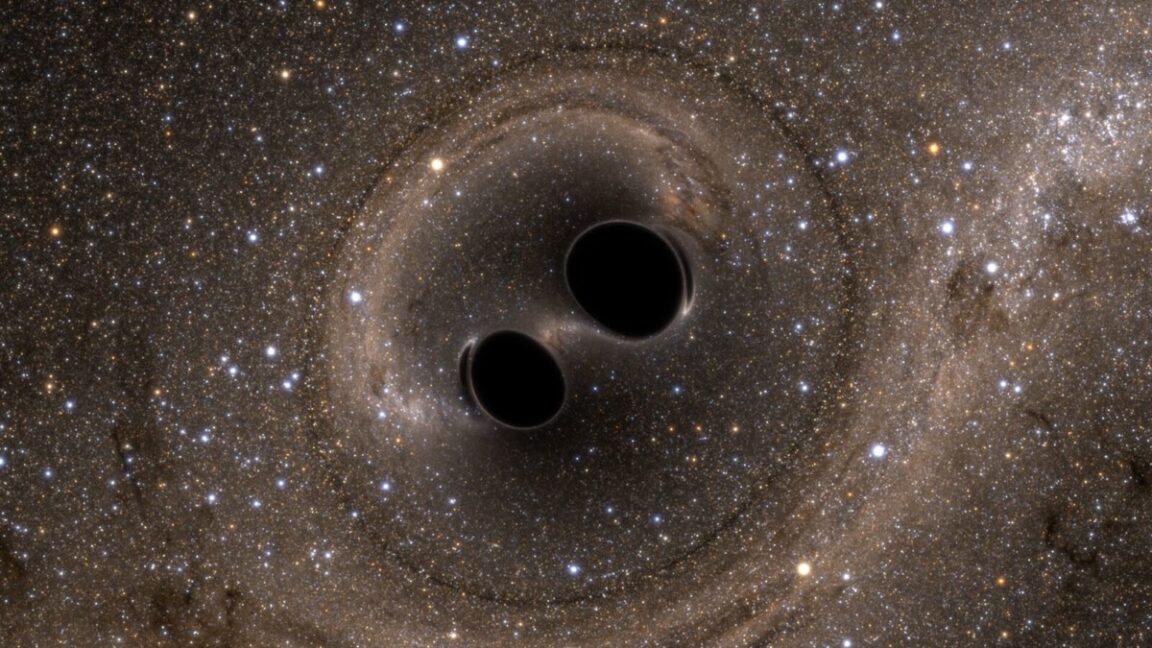
Physicists with the LIGO/Virgo/KAGRA collaboration have detected the gravitational wave signal (dubbed GW231123) of the most massive merger between two black holes yet observed, resulting in a new black hole that is 225 times more massive than our Sun. The results were presented at the Edoardo Amaldi Conference on Gravitational Waves in Glasgow, Scotland.
The LIGO/Virgo/KAGRA collaboration searches the universe for gravitational waves produced by the mergers of black holes and neutron stars. LIGO detects gravitational waves via laser interferometry, using high-powered lasers to measure tiny changes in the distance between two objects positioned kilometers apart. LIGO has detectors in Hanford, Washington, and in Livingston, Louisiana. A third detector in Italy, Advanced Virgo, came online in 2016. In Japan, KAGRA is the first gravitational-wave detector in Asia and the first to be built underground. Construction began on LIGO-India in 2021, and physicists expect it will turn on sometime after 2025.
To date, the collaboration has detected dozens of merger events since its first Nobel Prize-winning discovery. Early detected mergers involved either two black holes or two neutron stars. In 2021, LIGO/Virgo/KAGRA confirmed the detection of two separate "mixed" mergers between black holes and neutron stars.
A tour of Virgo. Credit: EGO-Virgo
LIGO/Virgo/KAGRA started its fourth observing run in 2023, and by the following year had announced the detection of a signal indicating a merger between two compact objects, one of which was most likely a neutron star. The other had an intermediate mass—heavier than a neutron star and lighter than a black hole. It was the first gravitational-wave detection of a mass-gap object paired with a neutron star and hinted that the mass gap might be less empty than astronomers previously thought.
Until now, the most massive back hole merger was GW190521, detected in 2020. It produced a new black hole with an intermediate mass—about 140 times as heavy as our Sun. Also found in the fourth run, GW231123 dwarfs the prior merger. According to the collaboration, the two black holes that merged were about 100 and 140 solar masses, respectively. It took some time to announce the discovery because the objects were spinning rapidly, near the limits imposed by the general theory of relativity, making the signal much more difficult to interpret.
The discovery is also noteworthy because it conflicts with current theories about stellar evolution. The progenitor black holes are too big to have formed from a supernova. Like its predecessor, GW190521, GW231123 may be an example of a so-called "hierarchical merger," meaning the two progenitor black holes were themselves each the result of a previous merger before they found each other and merged.
“The discovery of such a massive and highly spinning system presents a challenge not only to our data analysis techniques but will have a major effect on the theoretical studies of black hole formation channels and waveform modeling for many years to come," said Ed Porter of CNRS in Paris.
Hope you enjoyed this news post.
News posts... 2023: 5,800+ | 2024: 5,700+ | 2025 (till end of June): 2,864
RIP Matrix | Farewell my friend
Recommended Comments
There are no comments to display.
Join the conversation
You can post now and register later. If you have an account, sign in now to post with your account.
Note: Your post will require moderator approval before it will be visible.