

3175x175(CURRENT).thumb.jpg.b05acc060982b36f5891ba728e6d953c.jpg)
A rigid ice shell over a shrinking interior makes for pressures low enough to boil.
Our exploration of the outer Solar System has revealed a host of icy moons, many with surface features that suggest a complex geology. In some cases, these features—most notably the geysers of Enceladus—hint at the presence of oceans beneath the icy surfaces. These oceans have been ascribed to gravitational interactions that cause flexing and friction within the moon, creating enough heat to melt the body’s interior.
Something that has received a bit less attention is that some of these orbital interactions are temporary or cyclical. The orbits of any body are not always regular and often have long-term cycles. That’s also true for the other moons that provide the gravitational stress. As a result, the internal oceans may actually come and go, as the interiors of the moons melt and refreeze.
A new study, released today by Nature Astronomy, looks at one of the consequences of the difference in density between liquid water and ice (about 10 percent): the potential for the moon’s interior to shrink as it melts, leaving an area of low pressure immediately below its icy shell. If the moon is small enough, this study suggests, that could cause the surface of the ocean to boil.
Shifting ice
It can be tempting to think of the Solar System’s current configuration as being relatively static. But that’s definitely not the case; there are plenty of hints that the outer planets moved around a bit early in their history. And, even in its present state, the Earth experiences long-term orbital cycles that drive its entry to and exit from ice ages. The moon systems of the outer planets have the potential for even more complex interactions, with many individual bodies of varying sizes sharing space with a giant planet.
So, it’s easy to think that any oceans are the product of constant forces and were therefore always present. Or that the moons started out hot due to their formation and have been gradually cooling since. But the reality is that the tidal heating that drives the formation of these oceans can come and go over time and that the moons may experience periodic meltings and refreezings.
That can have significant consequences on the stresses experienced by the icy shells of these moons. Water is considerably more dense than ice. So, as a moon’s ocean freezes up, its interior will expand, creating outward forces that press against the gravity holding the moon together. The potential of this transition to shape the surface geology of a number of moons, including Europa and Enceladus, has already been explored. So, the researchers behind the new work decided to look at the opposite issue: what happens when the interior starts to melt?
Rather than focus on a specific moon, the team did a general model of an ice-covered ocean. This model treated the ice shell as an elastic surface, meaning it wouldn’t just snap, and placed viscous ice below that. Further down, there was a liquid ocean and eventually a rocky core. As the ice melted and the ocean expanded, the researchers tracked the stresses on the ice shell and the changes in pressure that occurred at the ice-ocean interface. They also tracked the spread of thermal energy through the ice shell.
Pressure drop
Obviously, there are limits to how much the outer shell can flex to accommodate the shrinking of the inner portions of the moon that are melting. This creates a low-pressure area under the shell. The consequences of this depend on the moon’s size. For larger moons—and this includes most of the moons the team looked at, including Europa—there were two options. For some, gravity is sufficiently strong to keep the pressure at a point where the water at the interface remains liquid. In others, the gravity was enough to cause even an elastic surface to fail, leading to surface collapse.
For smaller moons, however, this doesn’t work out; the pressure gets low enough that water will boil even at the ambient temperatures (just above the freezing point of water). In addition, the low pressure will likely cause any gases dissolved in the water to be released. The result is that gas bubbles should form at the ice-water interface. “Boiling is possible on these bodies—and not others—because they are small and have a relatively low gravitational acceleration,” the researchers conclude. “Consequently, less ocean underpressure is needed to counterbalance the [crustal] pressure.”
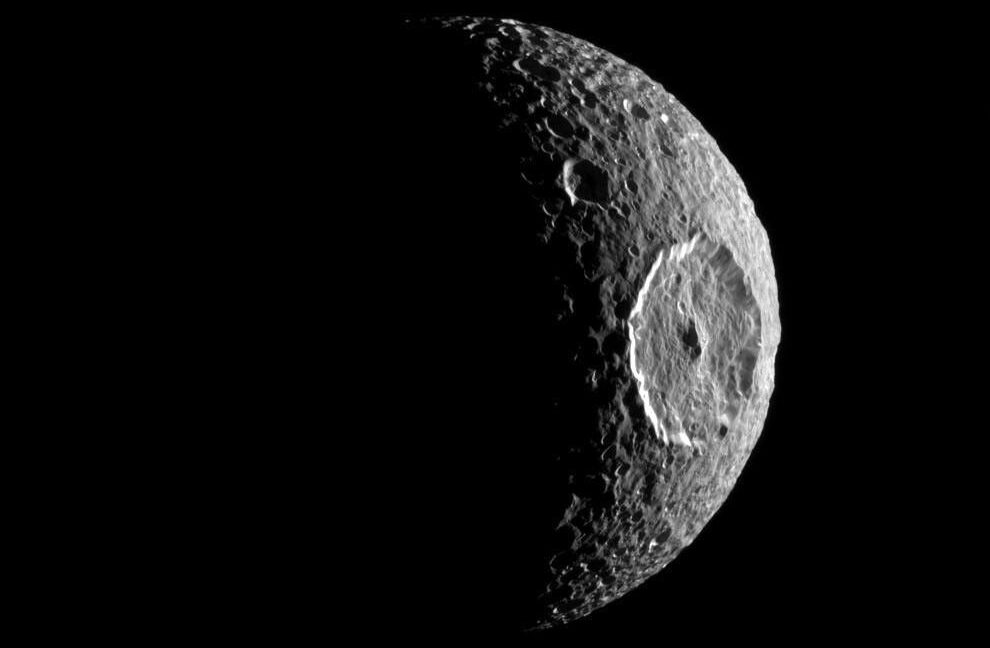
How small does a moon have to be? Only three of the moons they examined are likely to have boiling oceans. One of them is Enceladus, famed for the geysers it produces in its southern hemisphere. Two others are Mimas, a small moon of Saturn, and Miranda, which orbits Uranus. Mimas is especially intriguing, given that evidence suggests that it might have recently developed its ocean (at least recently in astronomical terms).
None of this requires an especially deep ocean. The researchers estimate that Enceladus would only need to melt an ocean about 14 km deep in order to create the conditions where boiling is possible; for Mimas, it’s only 5 kilometers.
The researchers are careful to acknowledge that we don’t really know the implications of this, writing, “The fate of vapor generated in a subsurface ocean is uncertain.” They suggest it could act a bit like the liquid magma does in our crust, forcing its way into fractures and imperfections in the icy crust. The water should be cool enough to condense there, while others gases released from the water should remain in the gaseous phase, potentially extending any fractures.
The real question is what any of this means from the perspective of the surface. It’s possible that the failure of the crust due to the lack of pressure will create different features from the ones you’d see being generated by gas-driven fracturing. Unfortunately, the three moons where that sort of event might be happening don’t look a whole lot like each other. So, it’s possible that we’ll need to have more examples than our Solar System can provide to get a clear picture of what’s going on.
Nature Astronomy, 2025. DOI: 10.1038/s41550-025-02713-5 (About DOIs).
Hope you enjoyed this news post. Feedback welcome.
Posted Wednesday 26 November 2025 at 3:33 am AEST (my time).
News posts... 2023: 5,800+ | 2024: 5,700+ | 2025 (till end of October): 5,009
Recommended Comments
There are no comments to display.
Join the conversation
You can post now and register later. If you have an account, sign in now to post with your account.
Note: Your post will require moderator approval before it will be visible.