

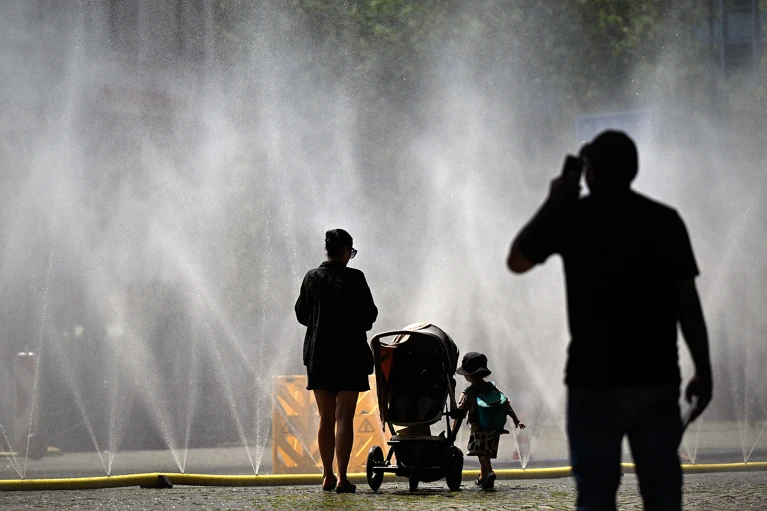

Nature asks researchers whether scorching summers are the new norm for London, Paris and Berlin.
As the second unprecedented heatwave in Europe this year smashes temperature records, many people are asking the same questions: is this the new normal? Has Europe’s climate fundamentally changed?
Scientists who spoke to Nature say that a European heatwave lasting four or five days, with London approaching 40 °C, is an anomaly. “It’s nothing short of phenomenal,” notes Sarah Perkins-Kirkpatrick, a climate scientist at the Australian National University in Canberra. But researchers also say that Europeans can expect to see more of these events in the future as global warming continues.
“Heatwaves are here to stay, until we turn the tap off to global emissions,” says Samantha Burgess, deputy director of the Copernicus Climate Change Service at the European Centre for Medium-Range Weather Forecasts in Reading, UK. “They’re more frequent, they’re more intense and they’re lasting longer.”
The risks are severe. In France — which recorded its hottest day ever this week, reaching 44.3 °C in the town of Pissos — at least 54 people have died from the heat or from drowning in waterways while trying to cool off.
What researchers don’t necessarily agree on is how quickly Europe’s climate shifted from one of cool, pleasant summers, during which residents could leave their windows open, to one dominated by extreme heat and questions about whether to buy an air conditioner.
New highs
An analysis released today1 examined temperatures in 854 cities across Europe — home to 30% of the population — and found that nearly half of them broke or will break their all-time heat-stress records this month (see ‘Epic heatwave’). Every city examined in the Czech Republic, Lithuania and Luxembourg has seen unprecedented highs according to the study, which was conducted by the World Weather Attribution group, an international organization that studies extreme weather events.
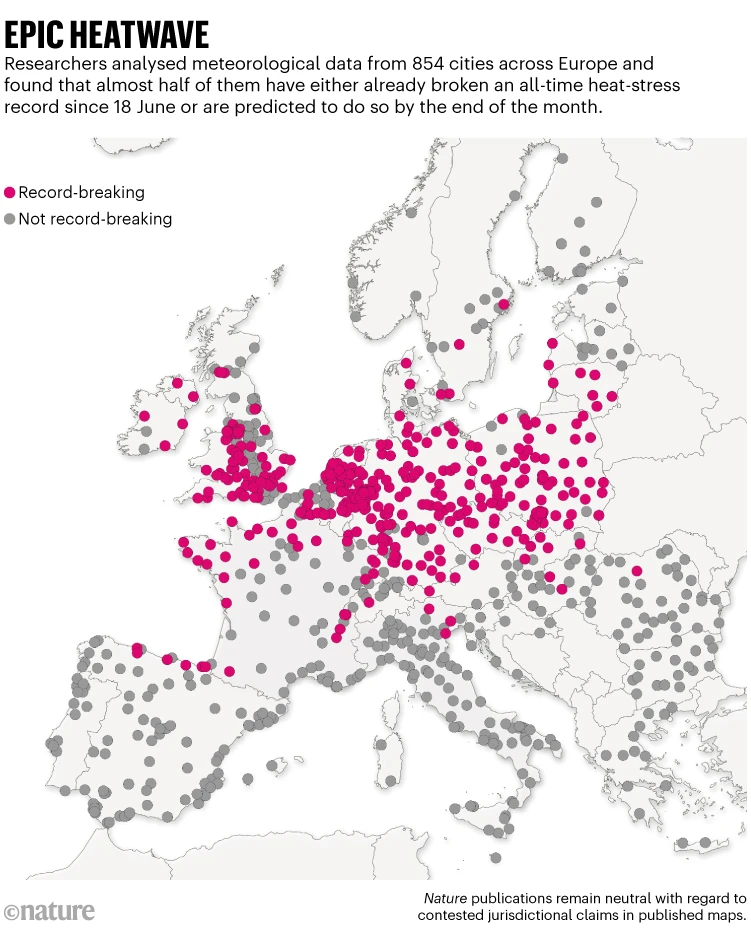
Source: Ref. 1/World Weather Attribution
“What used to be rare has become a regular event,” says Erich Fischer, a climate scientist at the Swiss Federal Institute of Technology (ETH) in Zurich. Temperature records “are just happening all the time, everywhere, and actually even being broken by large margins.” The record-setting in Europe would be unthinkable in sports, he says — it would be like a high-jumper “on steroids” breaking a record by half a metre, rather than by a centimetre or two.
So what’s causing the current heatwave? Like past ones, it was triggered by air circulation patterns that bring heat from the Equator to the frigid North Pole, says Lara Wallberg, a climate modeller at the Max Planck Institute for Meteorology in Hamburg, Germany. Although this air circulation isn’t fully understood, some scientists think2 that when sea surface temperatures in the North Atlantic Ocean dip, as they are doing now, hot air from North Africa and the Sahara Desert can be temporarily trapped above Europe, says Stefan Rahmstorf, a climate scientist at Potsdam University in Germany.
‘Glaringly obvious’
Climate change is also playing a part in the severity of this particular heatwave, researchers say. On top of that, high temperatures caused by global warming have dried out soil and reduced evaporative cooling in Europe, says Clair Barnes, an extreme-weather researcher at Imperial College London. Cloud cover that would normally reflect heat from the Sun back out into space has also declined over Europe, owing to a combination of dry conditions and stricter air-quality laws since the 1980s that have reduced aerosol pollution, Barnes adds. (Aerosols can act as scaffolds to seed clouds.)
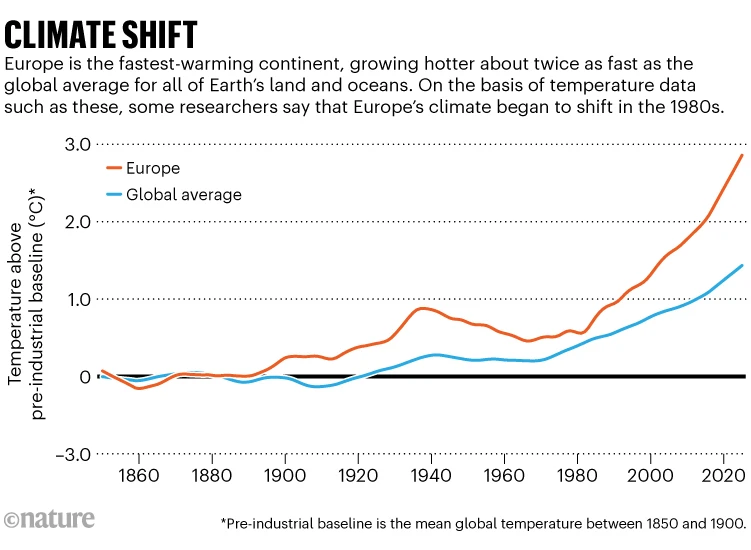
In fact, some scientists think that Europe began its transition to a distinct climate in the 1980s (see ‘Climate shift’). “Particularly since 1980, there’s just been this enormous spike in global temperatures in Europe,” says Zeke Hausfather, a climate scientist at Berkeley Earth, a non-profit organization in California that tracks global temperatures. “It’s pretty glaringly obvious in the data.”
Updates & Corrections
Clarification 26 June 2026: This story was updated to clarify Ségolène Berthou's view that Europe will keep warming if emissions continue.
References
-
Keeping, T. et al. Fossil Fuel Emissions have Rapidly Worsened European Heatwaves in Just a Few Decades (World Weather Attribution, 2026).
-
Krüger, J., Kjellsson, J., Kedzierski, R. P. & Claus, M. Tellus 75, 358–374 (2023).
-
Copernicus Climate Change Service & World Meteorological Organization. European State of the Climate Report 2025 (ECMWF & WMO, 2026).
-
Boboc, L., Dima, M., Vaideanu, P. & Ionita, M. Weather Clim. Extrem. 49, 100794 (2025).
-
Zhang, R., Sun, C., Zhu, J., Zhang, R. & Li, W. npj Clim. Atmos. Sci. 3, 7 (2020).
- Mutton
-
 1
1
Recommended Comments
There are no comments to display.
Join the conversation
You can post now and register later. If you have an account, sign in now to post with your account.
Note: Your post will require moderator approval before it will be visible.