

3175x175(CURRENT).thumb.jpg.b05acc060982b36f5891ba728e6d953c.jpg)
Male dragonflies’ dramatic aerial combat maneuvers emerge from relatively simple vision-based rules.
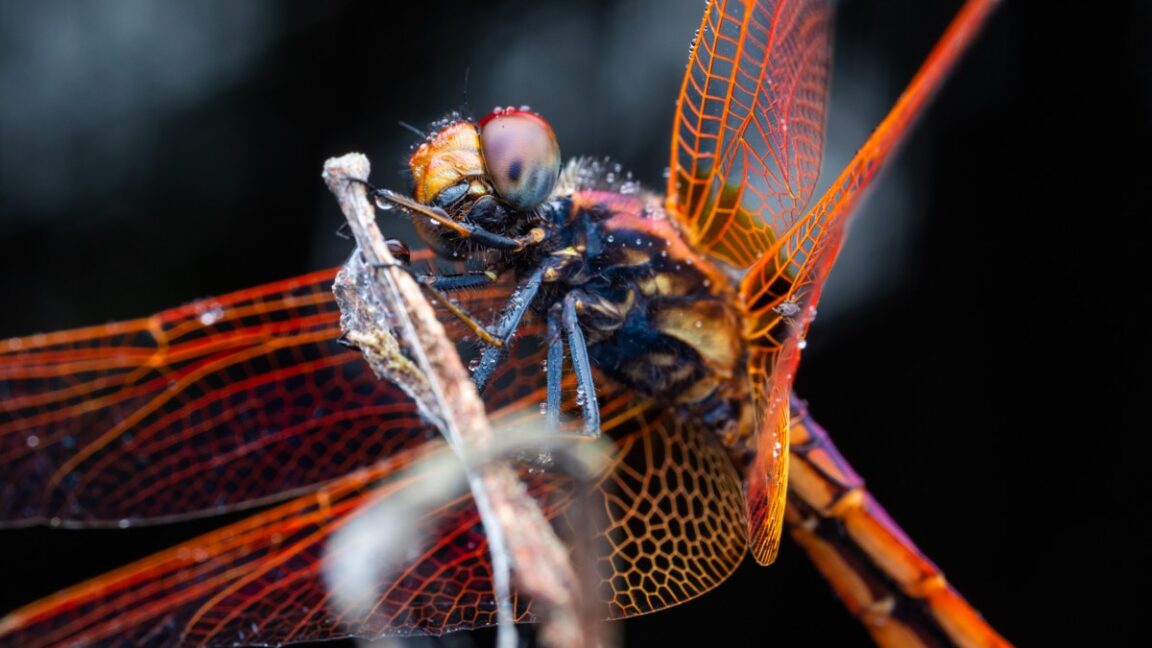
Male dragonflies are known to engage in mid-air “dogfights” to defend their breeding territory, using different maneuvers than those they employ when hunting prey. A new paper published in the Journal of the Royal Society Interface concluded that relatively simple rules drive that behavior, namely that male dragonflies are trying to maintain a tactical position. This mirrors the tactics of human fighter pilots. The research could lead to the development of smarter drones capable of navigating with simple, vision-based guidance rather than complex computation.
Classic pursuits involving prey or mating rituals are asymmetric: there is a chaser and an evader, with each role requiring different maneuvers. In the case of male-on-male interactions, however, it is more of a mutual pursuit, per the authors, who thought that studying flight trajectories of insects or raptors could yield useful insights into the guidance laws that underlie the behavior. They chose the Trithemis Aurora species of dragonfly for study because the males are “fiercely territorial,” and there are usually multiple males around a given pond, intent on defending their chosen perches. The dragonflies are also crimson-colored, making them easier to track.
Much of the prior research on dragonfly interactions relied on visual observations or single-camera recordings. For this study, the authors set up a portable stereovideographic rig with two shutter-synchronized cameras to record dragonfly interactions in both color and monochrome, and then reconstructed 102 paired male-on-male flight trajectories to capture the 3D kinematics. They also reconstructed nine trajectories for dragonflies intercepting prey for comparative purposes. This enabled the authors to develop a model for the rules governing the flight behavior.
Chasing the tail
The resulting analysis confirmed marked differences in flight behavior when dragonflies were hunting prey versus defending their territory from other male dragonflies via “dogfight” displays. When hunting, the dragonflies approached their prey from below, so prey was often viewed silhouetted against the sky. Dogfighting males showed more highly convoluted trajectories and were more likely to be viewed against a background of foliage or the ground.

In fact, the researchers found that the male dragonflies’ aerial combat behavior closely resembled that of human fighter pilots, with the two insects competing to achieve an advantageous position behind their opponent (chasing the tail). Furthermore, a pilot will use high-G maneuvers like downward vertical turns and spirals, and those maneuvers are strikingly similar to dragonflies engaged in aerial combat. The authors suspect this similar behavior might be because fighter jets deploy forward-facing weapon-radar systems and dragonflies have a frontally biased vision system ideal for detecting targets in front of them.
In other words, it’s not just a chase; it’s a duel, with dragonflies competing for positional advantage rather than trying to intercept, as they would do when hunting prey. That objective naturally leads the insects to rely on loops and spiral flight patterns, repeatedly switching their “chaser” and “evader” roles. Among other findings: The dragonflies can pull turns up to 6 Gs but usually avoid ramping up to top speeds in exchange for better maneuverability. And the dragonflies glide at least one-third of the time even during the most intense dogfights—possibly to conserve energy, or perhaps because it’s easier for them to visually track a target while gliding. They rely on flapping to execute sharp turns.
There is at least one significant difference between dragonflies and fighter pilot flight maneuvers. “Fighter pilots treat altitude as a reserve of potential energy that can be traded for airspeed during combat through diving maneuvers,” the authors write. “For an equivalent speed, the pilot would rather be higher in altitude than their opponent. Dragonflies do not appear to use altitude in this way, instead preferring to position themselves slightly below the opponent, without an energy advantage but with a potential visual tracking advantage.”
Journal of the Royal Society Interface, 2026. DOI: 10.1098/rsif.2026.0131 (About DOIs).
Hope you enjoyed this news post. Feedback welcome.
Posted Wednesday 8 July 2026 at 7:28 am AEST (my time).
News posts: 2023 5,800+ | 2024 5,700+ | 2025 5,700+ | 2026 (to end of June) 2,475
Recommended Comments
There are no comments to display.
Join the conversation
You can post now and register later. If you have an account, sign in now to post with your account.
Note: Your post will require moderator approval before it will be visible.