

3175x175(CURRENT).thumb.jpg.b05acc060982b36f5891ba728e6d953c.jpg)
“We wanted to get to an orbital launch vehicle in a few years.”
After decades of controlling all aspects of spaceflight, the Indian government decided in 2020 to open things up to private industry. Essentially, the government said, companies could build their own rockets, obtain permission to launch them, and even use state-operated facilities.
The government and the country’s space agency, ISRO, instituted this change in response to the rise of commercial space industries in the United States, and later China, that were playing an increasingly important role in global spaceflight.
Now, six years later, this structural shift is beginning to bear some fruit. The most promising Indian launch company, Skyroot Aerospace, is nearing the pad with its first orbital rocket.
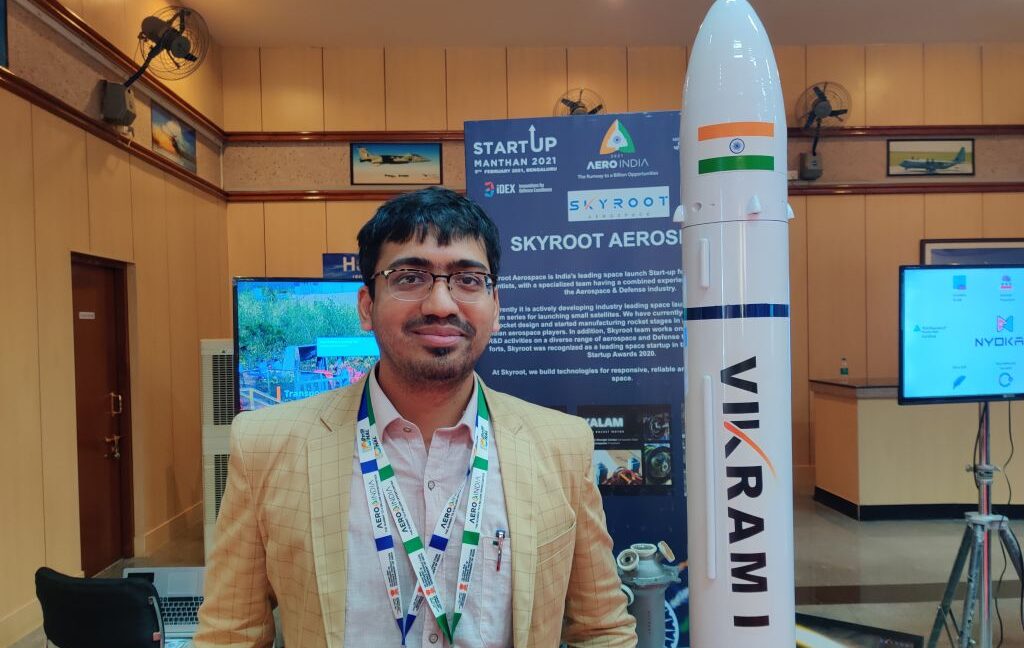
The Vikram-1 launch vehicle could take flight within the next couple of months, its cofounder and chief executive officer, Pawan Kumar Chandana, told Ars in an interview. And with a recent $60 million fundraising round valuing the firm at $1.1 billion, the company is poised to accelerate its commercial launch efforts.
The origins of Skyroot
Chandana graduated with an engineering degree from the Indian Institute of Technology in 2012, and like almost anyone in India interested in space at the time, he went to work for the Indian Space Agency. But six years later, he could see the coming disruption to the space industry and believed that India would soon follow suit.
“Going back to my school days, I always had the ambition to be an entrepreneur,” he said. “I was super inspired by what SpaceX was doing. Rocket Lab was also building up. The world definitely needed more access to space.”
Although India lacked a purely commercial space industry, Chandana believed that the rising country had the right ingredients in place. The country had great engineers, a supplier base, government spaceports, and an advantageous location near the equator.
Still, leaving ISRO was a major risk. Chandana had no guarantees that India would open up its launch industry to the private sector or even allow government payloads to fly on private rockets. But he believed that if he didn’t start working on a private launch company now, competitors in the United States, China, Europe, Japan, and elsewhere would pull even further ahead. So he and another ISRO scientist, Naga Bharath Daka, took the leap and founded Skyroot in June 2018 in Hyderabad.
Failure, he realized, was the most likely outcome.
Solids, first
For the first couple of years, a small team worked on concepts and designs. Early on, they decided to start with a solid-fuel design for the first stage because they understood it best and believed it offered the straightest path to the launch pad.
“We wanted to get to an orbital launch vehicle in a few years,” Chandana said of the choice to use solid-rocket fuel. “India has a really strong ecosystem there. And we believe that, with small launchers, they will be expendable. And the whole architecture has to scale to mass produce them at scale. So we optimized for the lowest development time and the lowest cost per launch.”
The company named its initial line of vehicles “Vikram” in honor of the Indian physicist Vikram Sarabhai, who is considered the father of the Indian Space Program. As a testbed for its technology, Skyroot worked on a suborbital version of its rocket, Vikram-S, from 2020 to 2022 and launched the 6-meter rocket in November of that year.
The sounding rocket’s flight was a major success, reaching an altitude of 90km and validating a lot of what Skyroot had planned for its larger orbital vehicle, Vikram-1. It accomplished this with minimal funding, only raising $15 million in the weeks before Vikram-S took flight.
Vikram-1 nears readiness
The Vikram-1 vehicle stands more than three times taller than the Vikram-S vehicle and is composed of three solid rocket fuel stages. It’s intended to put nearly half a metric ton of payload into low-Earth orbit. The structure is largely manufactured from carbon composites.
Each stage is powered by the Kalam-series of engines, with a single Kalam-1200 engine being used on the first stage.
“A single engine simplifies it so much compared to a traditional architecture of having multiple engines in the first stage with liquid fuel,” Chandana said. “It simplifies manufacturing and it simplifies testing. So it was an ideal fit, and it’s the reason for our speed.”
Chandana said building the individual components of the rocket, such as the engines, avionics, and separation systems, has been a fairly straightforward process. But integrating these into a single vehicle and testing the whole system has been “very, very challenging.” Still, the company is now in the final stretches of testing, and a launch could come this summer.
“It’s a test launch,” he said. ” Statistically, the first launch from a private company almost always fails. It’s very difficult to succeed with all new systems. But I think we have done everything we can do to ensure the first launch goes well.”
Big ambitions
The risk Chandana took in founding Skyroot before India opened up its space industry has paid off. The company appears to have a lead over its other competitors in the Indian launch startup ecosystem, such as Agnikul Cosmos. And the Indian government is now really leaning into the commercial space industry.
Jitendra Singh, India’s minister of state for science and technology, has said he wants the country to grow its share of the global space economy from 2 percent to 10 percent by 2030. And Prime Minister Narendra Modi has told the industry to increase its annual launch total from about five launches annually to 50 before the end of the decade.
For this to happen, Skyroot and other Indian companies will need to step up. Chandana said the recent funding will enable the company to continue working on the line of Vikram rockets, eventually building larger vehicles with liquid-fueled engines.
“We talk to customers every day, and we know how challenging it is to have real, regular, and affordable access to space,” he said. “And that’s the problem we are working to solve. We will be operating much larger vehicles, fully reusable, on a regular basis, with a daily cadence from multiple countries. That’s the aspiration for the company.”
Hope you enjoyed this news post. Feedback welcome.
Posted Tuesday 12 May 2026 at 7:18 am AEST (my time).
News posts: 2023 5,800+ | 2024 5,700+ | 2025 5,700+ | 2026 (to end of April) 1,700
Recommended Comments
There are no comments to display.
Join the conversation
You can post now and register later. If you have an account, sign in now to post with your account.
Note: Your post will require moderator approval before it will be visible.