


3175x175(CURRENT).thumb.jpg.b05acc060982b36f5891ba728e6d953c.jpg)
IIPA, which represents the movie, music, and software industries, wants China to take action against a sophisticated and growing trend of "export-only" piracy services. These pirate sites and apps are operated from China but blocked locally, presumably to evade local law enforcement. IIPA shared its concerns in a formal submission to the U.S. Trade Representative, highlighting MagisTV/FlujoTV and LokLok as prime examples.
The American copyright industry generates billions of dollars in annual revenue and its content is generally viewed as one of the country’s primary exports.
Whether they produce movies, music, software, or content for the publishing sector, U.S. companies are among the market leaders.
U.S. companies also have a clear presence in China, and with more than a billion potential consumers, it’s a massive market. This offers enormous potential, but there are threats as well, including various forms of piracy.
A few days ago, several of these threats were highlighted by the International Intellectual Property Alliance (IIPA), which counts copyright groups including the MPA, RIAA, and ESA among its members. The IIPA shared its concerns with the US Trade Representative as part of the annual review of China’s World Trade Organization (WTO) obligations.
U.S. Rightsholders Link MagisTV to China
The IIPA has repeatedly called out enforcement challenges and trade barriers in China, so it doesn’t come as a surprise that it’s highly critical of the country’s efforts to protect American rightsholders. On that front there are some new and notable developments.
Published earlier this week, the IIPA’s submission highlights MagisTV as a Chinese problem. The video piracy service recently rebranded as Flujo TV and is not popular in China at all. That’s no surprise, as it specifically targets Latin American users.
Thus far, most of the enforcement against (re)sellers of the pirate service has taken place in Latin America, but IIPA links the operation directly to China.
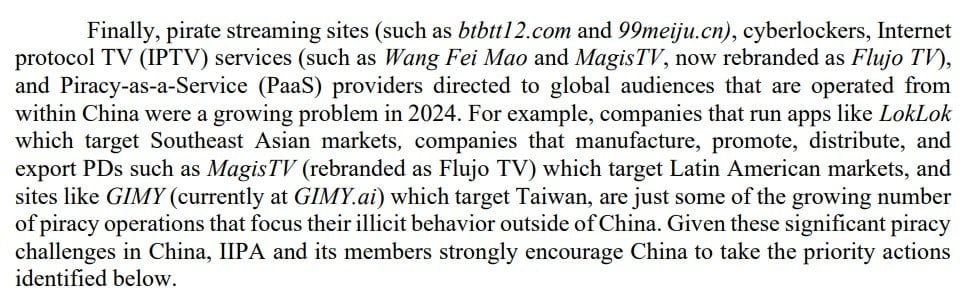
From IIPA’s submission
That MagisTV and its successor have links to China has been mentioned in previous policy submissions. In addition, the Chinese company ‘Shenzhen Huiyi Electronics’ applied for the MagisTV trademark at the U.S. Patent and Trademark Office, without success.
Piracy as an Export Service
According to the submission, a growing number of Chinese-origin piracy operations exclusively market their sites or services to audiences outside the country. This “export-only” scheme applies to MagisTV and others including LokLok and GIMY.
“[T]he exporting of pirated content, piracy services, and piracy devices (PDs) from China to foreign markets is a growing and equally troubling global trend,” it reads.
IIPA notes that these apps and services often geo-block access from within China to evade local enforcement. This suggests a deliberate and sophisticated strategy to operate globally without drawing attention from Chinese law enforcement.
There are civil and criminal enforcement actions in the country. The National Copyright Administration of China (NCAC), for example, has booked results against various piracy operations. However, IIPA notes that it doesn’t appear to take referrals for operations that have no local presence, effectively creating a loophole that should be closed.
“This allows China-based operations to evade enforcement action by simply geo-blocking their services from access within China or serving a different set of content to users accessing these services from within China,” IIPA writes.
More Problems & Solutions
The IIPA recognizes that China has made progress recently but new problems continue to emerge. For example, where gaming pirates previously cracked games, they now often reskin the software to make it look different which presumably makes enforcement more difficult.
“Instead of traditional methods that involve technical cracking of game software for complete duplication and distribution, game piracy in China is increasingly characterized by reskinning the original games with non-substantial revisions,” IIPA’s submission reads.
To tackle the reskinning problem, China should amend its copyright law by classifying video games as a distinct type of copyrightable work, IIPA argues. This would make it easier to establish infringement when a game’s overall elements are copied.
The IIPA also lists a series of suggestions to address the “export-only” piracy apps and services. This includes expanding the enforcement scope to Chinese-run services operating outside the country, as well as a general improvement of cross-border enforcement cooperation to tackle problems more effectively.
All in all, the submission highlights an ongoing game of cat-and-mouse where pirates exploit technology and enforcement loopholes to stay a step ahead of those who try to shut them down.
—
A copy of IIPA’s filing regarding China’s WTO compliance, submitted to the U.S. Trade Representative, is available here (pdf).
Hope you enjoyed this news post. Feedback welcome.
Posted Thursday 2 October 2025 at 4:30 am AEST (my time).
News posts... 2023: 5,800+ | 2024: 5,700+ | 2025 (till end of August): 4,048
Recommended Comments
There are no comments to display.
Join the conversation
You can post now and register later. If you have an account, sign in now to post with your account.
Note: Your post will require moderator approval before it will be visible.