


3175x175(CURRENT).thumb.jpg.b05acc060982b36f5891ba728e6d953c.jpg)
In an effort to gather material for its LLM training, Meta used BitTorrent to download pirated books from Anna’s Archive and other shadow libraries. According to several authors, Meta facilitated the infringement of others by "seeding" these torrents. This week, the court granted the authors permission to add these claims to their complaint, despite openly scolding their counsel for "lame excuses" and "Meta bashing."

Over the past two years, rightsholders of all kinds have filed lawsuits against companies that develop AI models.
Most of these cases allege that AI developers used copyrighted works to train LLMs without first obtaining authorization.
Meta is among a long list of companies now being sued for this allegedly infringing activity. This includes a class action lawsuit filed by authors including Richard Kadrey, Sarah Silverman, and Christopher Golden, which accused Meta of using libraries of pirated books as training material.
Court Dismisses AI Training Claims
Last summer, Meta scored a key victory in this case, as the court concluded that using pirated books to train its Llama LLM qualified as fair use, based on the arguments presented in this case. This was a bittersweet victory, however, as Meta remained on the hook for downloading and sharing the books via BitTorrent.
By downloading books from shadow libraries such as Anna’s Archive, Meta relied on BitTorrent transfers. In addition to downloading content, these typically upload data to others as well. According to the authors, this means that Meta was engaged in widespread and direct copyright infringement.
In recent months, the lawsuit continued based on this remaining direct copyright infringement claim. While this was unfolding, the authors’ legal team also ‘discovered’ a new claim
Authors Pivot to Seeding Claim
Last December, the authors, through their attorneys, requested leave to file a fourth amended complaint. Specifically, they want to add a contributory copyright infringement claim, alleging that Meta facilitated third-party copyright infringement by seeding pirated books to others.
While the BitTorrent angle is not new, the authors previously only included a ‘distribution’ claim based on direct copyright infringement. This claim has a higher evidence standard, as it typically requires evidence that the infringer shares a whole work with a third party.
Since BitTorrent transfers break up files into smaller chunks before they are shared, it might be difficult to prove that a whole work is shared. However, the same transfers can be evidence that an infringer facilitated torrent transfers to third parties.
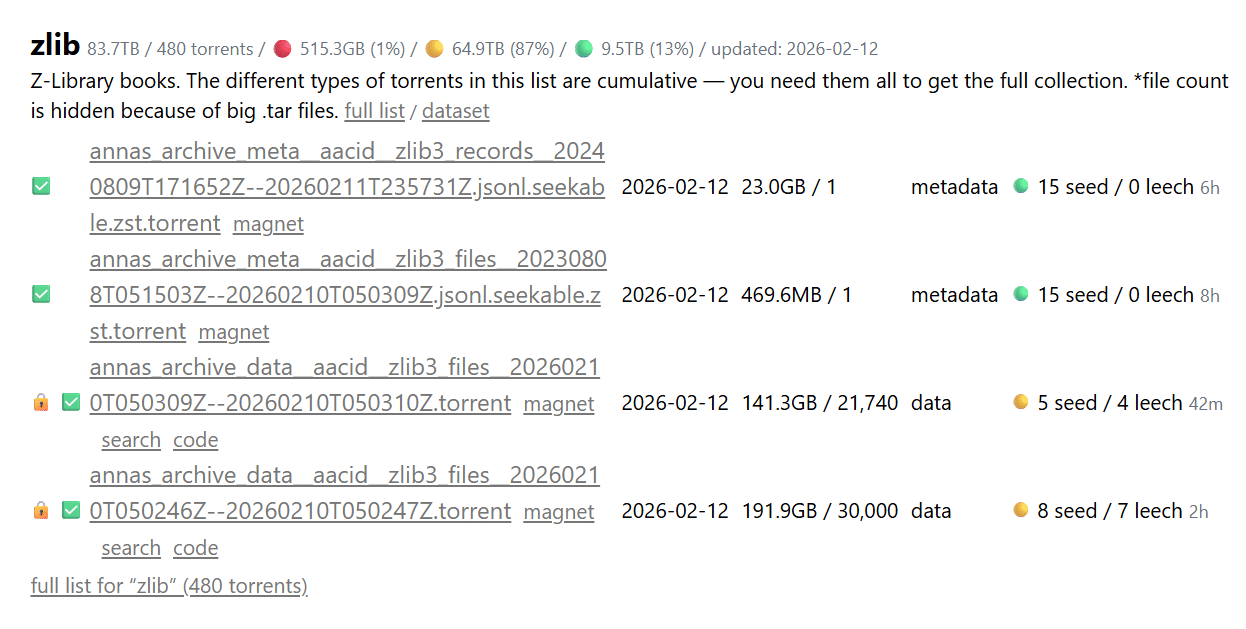
Anna’s Archive torrents (illustrative)
Court Grants BitTorrent Pivot, Despite Doubletalk
This week, U.S. District Court Judge Vince Chhabria granted the motion, but made little effort to hide his frustration with how plaintiffs’ counsel handled it.
The judge acknowledged that the contributory infringement claim could and should have been added back in November 2024, when the authors amended their complaint to include the distribution claim. After all, both claims arise from the same factual allegations about Meta’s torrenting activity.
“The lawyers for the named plaintiffs have no excuse for neglecting to add a contributory infringement claim based on these allegations back in November 2024,” Judge Chhabria wrote.
The lawyers of the book authors claimed that the delay was the result of newly produced evidence that had “crystallized” their understanding of Meta’s uploading activity. However, that did not impress the judge.
He called it a “lame excuse” and “a bunch of doubletalk,” noting that if the missing discovery truly prevented the contributory claim from being added in November 2024, the same logic would have prevented the distribution claim from being added at that time as well.
“Rather than blaming Meta for producing discovery late, the plaintiffs’ lawyers should have been candid with the Court, explaining that they missed an issue in a case of first impression..,” the order reads.
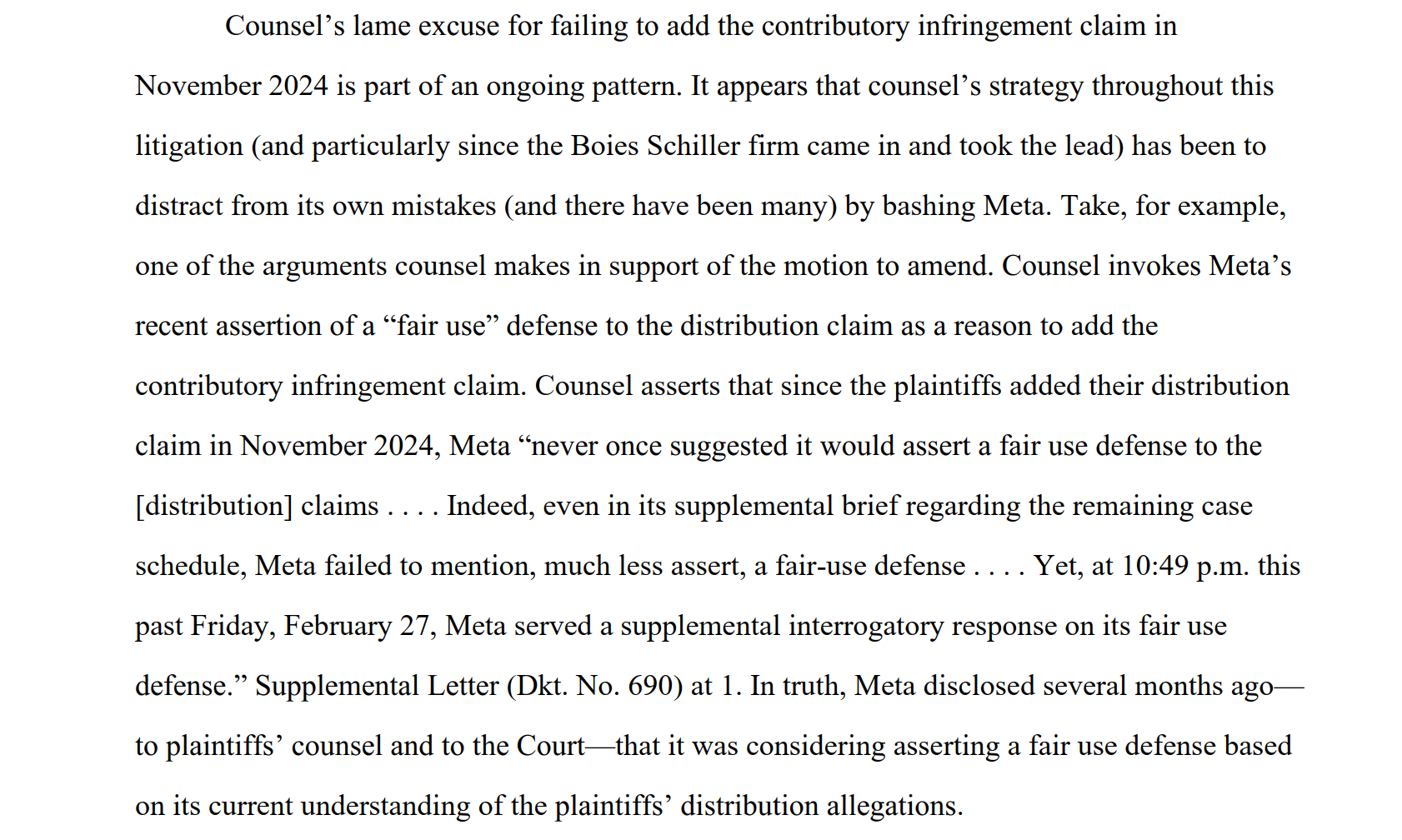
Lame excuse…
Judge Chhabria went further, noting that the authors’ law firm, Boies Schiller, showed “an ongoing pattern” of distracting from its own mistakes by attacking Meta. He pointed specifically to the dispute over when Meta disclosed its fair use defense to the distribution claim, which we covered here recently, characterizing it as a false distraction.
“The lawyers for the plaintiffs seem so intent on bashing Meta that they are unable to exercise proper judgment about how to represent the interests of their clients and the proposed class members,” the order reads.
Counsel “Lucked Into” a Pass
Despite the criticism, Chhabria granted the motion. The judge anticipated the obvious question from readers of his order.
“By now, the reader might be thinking, ‘Wait a minute, you started off saying that the motion to amend the complaint was difficult. It seems like an easy deny to me,'” Chhabria wrote.
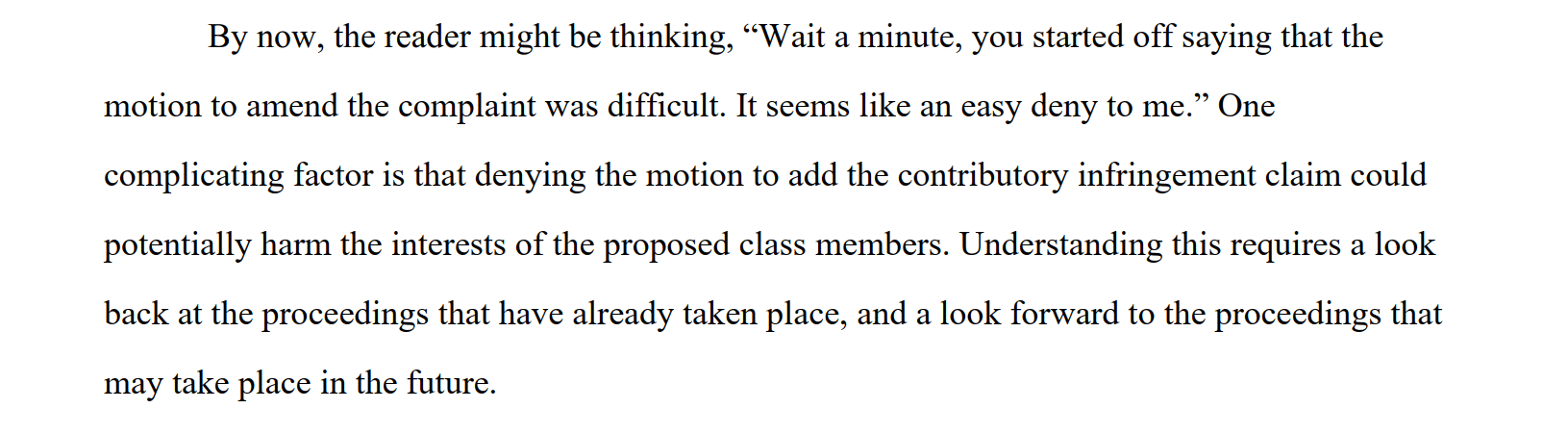
Wait a Minute…
The primary reason to grant the motion is the risk to the other potential members of the class action. If the contributory infringement claim were excluded and the class later lost on the distribution claim at trial, those class members could potentially be barred from ever bringing the contributory claim separately.
A second factor also made the decision easier. Meta has separately requested the court to align the schedule in this case with a separate but similar lawsuit filed by Entrepreneur Media. This case covers a similar contributory infringement claim and shares discovery the authors’ lawsuit. Granting the motion to amend, therefore, adds little practical burden to Meta.
However, the judge stresses that this is the result of luck, rather than the skill of the authors’ counsel.
“Plaintiffs’ counsel has lucked into a situation where Meta will not be meaningfully prejudiced by the failure to add a contributory infringement claim back in November 2024,” Chhabria wrote.
The authors’ motion to open the class discovery process was denied. That will only be considered if the named plaintiffs survive the next round of summary judgment on both the distribution and contributory infringement claims.
For now, the case moves forward with a fourth amended complaint, three new loan-out companies added as named plaintiffs, and a growing list of BitTorrent-related claims for Judge Chhabria to resolve.
—
A copy of the order, filed at the U.S. District Court for the Northern District of California, is available here (pdf).
Hope you enjoyed this news post. Feedback welcome.
Posted Monday 30 March 2026 at 5:41 pm AEST (my time).
News posts: 2023 5,800+ | 2024 5,700+ | 2025 5,700+ | 2026 (to end of February) 854
- phen0men4
-
 1
1
Recommended Comments
There are no comments to display.
Join the conversation
You can post now and register later. If you have an account, sign in now to post with your account.
Note: Your post will require moderator approval before it will be visible.