


3175x175(CURRENT).thumb.jpg.b05acc060982b36f5891ba728e6d953c.jpg)
An in-depth analysis on AI training and copyright, commissioned by the European Parliament, cautions against repeating the mistakes of the early 2000s when online piracy boomed. Instead of suing AI companies into oblivion or relying on "opt-out" mechanisms, the report sees "statutory licenses" as the optimal solution. This effectively authorizes the use of copyrighted works for AI training and should ultimately benefit creators and AI companies.
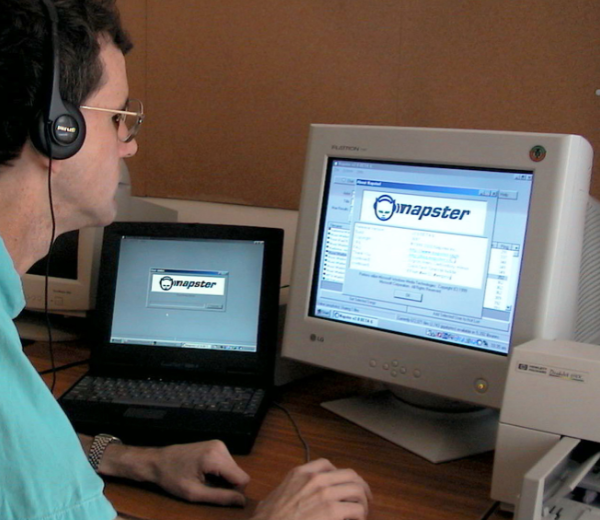
When Napster found its way to millions of desktop computers 25 years ago, the music industry was terrified by this apparent existential threat.
Determined to make the problem disappear, the legal response was swift. Within a year, the RIAA sued Napster, and artists such as Metallica and Dr. Dre soon followed.
This strategy seemed to work, as the RIAA lawsuit effectively shut down Napster two years after it launched. However, the genie was out of the bottle, and the ‘magic’ of unlimited access inspired many new sharing apps, such as LimeWire and Kazaa. These new applications eventually ran into trouble as well.
Report: The Economics of Copyright and AI
The massive legal response against file-sharing software in the early 2000s shows parallels with today’s copyright clashes between rightsholders and AI companies. Many rightsholders see AI as an existential threat, and there are dozens of high-profile lawsuits on the way. Meanwhile, lawmakers are considering if they need to intervene.
According to a new report prepared for the European Parliament, lawsuits were not the right answer to piracy, and they are not going to solve the current AI challenges either. Titled “The Economics of Copyright and AI”, the report was commissioned by the European Parliament’s Committee on Legal Affairs (JURI) to help shape future legislation.
The Economics of Copyright and AI
The report’s author, Christian Peukert, Professor of Digitization, Innovation, and Intellectual Property, has extensively researched both AI and piracy-related copyright challenges in the past.
Enforcement Doesn’t Work
The general conclusion is that creating too many barriers to using content for AI training data will harm the economy and the public. Instead, the EU should look to the “lessons from history” provided by online piracy.
One of the lessons is that early anti-piracy actions and legislation, such as the lawsuits against Napster or new anti-piracy laws in France and Sweden, were largely ineffective. These measures typically led to short-lived sales increases that quickly disappeared, as pirates simply switched to new sites and services.
The turning point came when licensed downloads and streaming services were made available to the public. Starting with iTunes, which pioneered music downloads, later spreading to streaming services such as Spotify and Netflix.
“These innovations successfully shifted consumer behavior towards legal consumption. Aggregate data indicate that unlicensed music consumption has been continuously decreasing since 2010, while consumption of unlicensed movie and TV show content has been stagnant and slower to decrease,” Professor Peukert writes.
Compulsory, Statutory Licensing
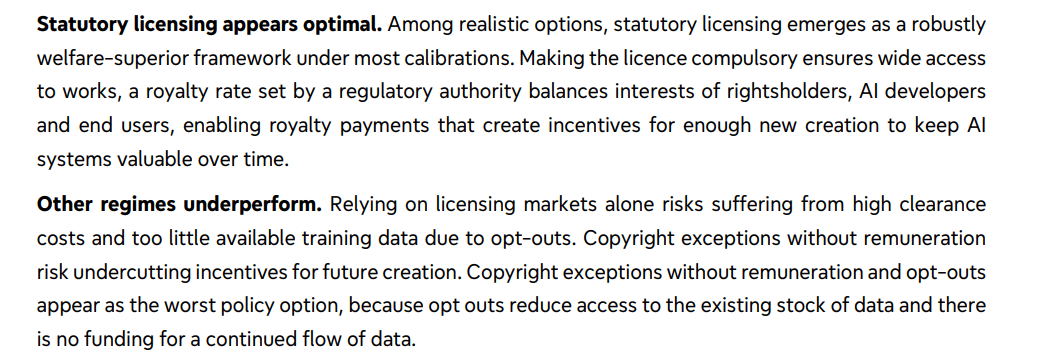
Instead of slowing down AI development by restricting access to copyrighted content, the report suggests a system of compulsory, statutory licensing. This would effectively give AI developers the guaranteed right to use all published works. In exchange, an independent authority would set a royalty rate to compensate rightsholders.
This would effectively authorize the use of copyrighted works for AI training, as some countries are already doing. However, in this case, rightsholders would receive compensation.
Key Findings
Statutory licensing is different from the licensing deals reached with online streaming services such as Spotify and Netflix. The report recognizes that but notes that direct licensing models are not a great solution for the scale of AI training.
While Spotify deals with a manageable number of record labels and publishers, AI models require training data from the entire internet, including billions of texts, images, and videos. The report argues that identifying and negotiating with millions of individual website owners, creators, and photographers is effectively impossible.
This individual license approach would be particularly problematic for smaller AI startups, which don’t have the resources to negotiate thousands of deals.
No Opt-Out
Perhaps most controversially, the report warns against an “opt-out” model where rightsholders can exclude their content. It argues that opt-outs create “holes” in training data, which will lead to biased AI models.
From an economic welfare perspective, the report ranks the “opt-out” model as the worst possible option, even worse than doing nothing.
“When a rightsholder exercises opt-out, they do not take into account that this decreases value for society,” the report notes. The report concludes that rightsholders should not be allowed to opt-out from AI-training under any circumstance.
Napster Lessons
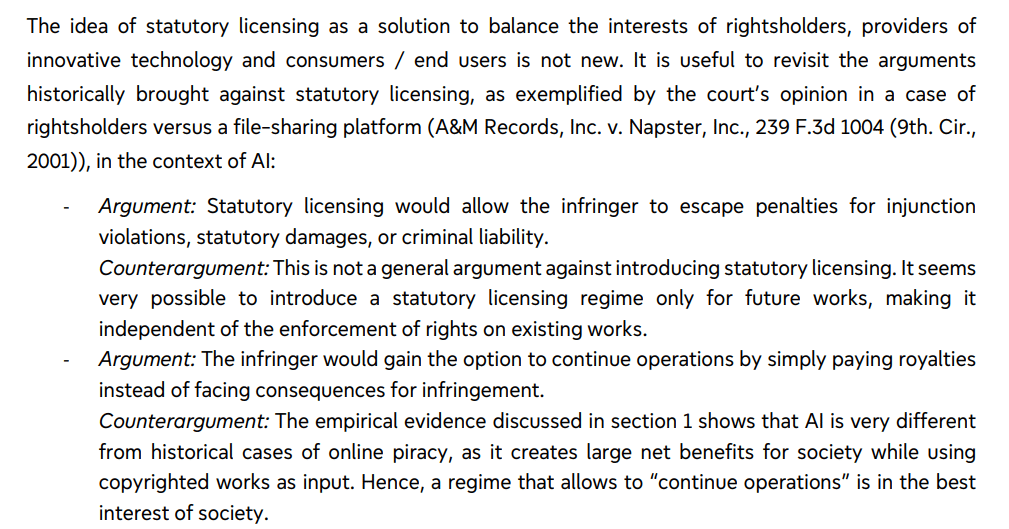
In the Napster case 25 years ago, the court explicitly rejected statutory licensing because it would allow an infringer to essentially pay a fine to keep breaking the law.
The report suggests that, this time around, the logic should be reversed. AI promises massive consumer benefit, estimated at $97 billion annually in the US alone, which is why the report argues that AI development should not be hindered.
For AI training, companies should be allowed to “continue operations” by paying a fee, because restricting access to copyrighted works would destroy too much economic value.
“… AI is very different from historical cases of online piracy, as it creates large net benefits for society while using copyrighted works as input. Hence, a regime that allows to ‘continue operations’ is in the best interest of society,” the report reads.
Napster arguments
Based on these historical lessons and detailed economic welfare models, the report sees compulsory statutory licensing as the best way to tackle the AI copyright challenges in Europe. Whether rightsholders and lawmakers will agree has yet to be seen, of course.
—
Peukert, C. (2025). The Economics of Copyright and AI. European Parliament, Policy Department for Justice, Civil Liberties and Institutional Affairs. doi:10.2861/0246137 (pdf)
Hope you enjoyed this news post. Feedback welcome.
Posted Tuesday 9 December 2025 at 3:44 am AEST (my time).
News posts... 2023: 5,800+ | 2024: 5,700+ | 2025 (till end of November): 5,412
Recommended Comments
There are no comments to display.
Join the conversation
You can post now and register later. If you have an account, sign in now to post with your account.
Note: Your post will require moderator approval before it will be visible.